Ch.1 - Introduction: Matter, Energy, and Measurement
Brown - Chemistry: The Central Science 15th Edition
Brown15th EditionChemistry: The Central ScienceISBN: 9780137542970당신이 사용하는 게 아니라요?교과서 변경
1장, 문제 57a

a. A bumblebee flies with a ground speed of 15.2 m/s. Calculate its speed in km/h.

검증된 단계별 안내
1
Convert the speed from meters per second (m/s) to kilometers per hour (km/h) by using the conversion factor: 1 m/s = 3.6 km/h.
Multiply the given speed in m/s by the conversion factor to find the speed in km/h.
Set up the equation: speed in km/h = 15.2 m/s * 3.6 km/h per m/s.
Perform the multiplication to find the speed in km/h.
Ensure the units are correctly converted and the final answer is in km/h.

비슷한 문제에 대한 검증된 영상 답변:

이 영상 해법은 위 문제에 도움이 된다고 튜터들이 추천한 것입니다.
영상 길이:
3m

주요 개념

질문에 올바르게 답하기 위해 반드시 이해해야 하는 핵심 개념들은 다음과 같습니다.

Unit Conversion

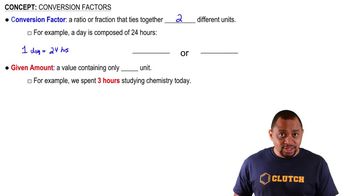
Unit conversion is the process of converting a quantity expressed in one set of units to another. In this case, we need to convert the speed of the bumblebee from meters per second (m/s) to kilometers per hour (km/h). This involves using conversion factors, specifically knowing that 1 km equals 1000 meters and 1 hour equals 3600 seconds.
추천 영상:
가이드 코스
01:56
Conversion Factors

Speed

Speed is a measure of how fast an object is moving, defined as the distance traveled per unit of time. It is a scalar quantity, meaning it has magnitude but no direction. In this question, the speed of the bumblebee is given in m/s, which indicates how many meters it travels in one second.
추천 영상:
가이드 코스
00:57
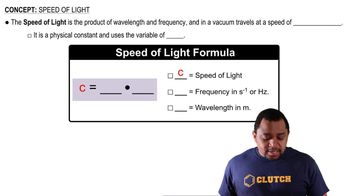
Speed of Light Formula

Dimensional Analysis

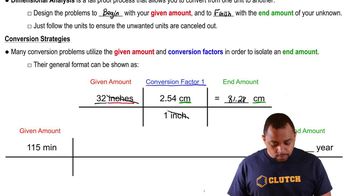
Dimensional analysis is a mathematical technique used to convert one set of units to another by using conversion factors. It ensures that the units cancel appropriately, leading to the desired unit. This method is particularly useful in physics and chemistry for verifying that equations are dimensionally consistent and for performing unit conversions accurately.
추천 영상:
가이드 코스
06:11
Dimensional Analysis