Ch.1 - Introduction: Matter, Energy, and Measurement
Brown - Chemistry: The Central Science 15th Edition
Brown15th EditionChemistry: The Central ScienceISBN: 9780137542970당신이 사용하는 게 아니라요?교과서 변경
1장, 문제 56d

Determine the appropriate conversion factors for the following: d. ft3 to L

검증된 단계별 안내
1
Start by identifying the relationship between cubic feet and liters.
Recall that 1 cubic foot (ft^3) is equivalent to 28.3168 liters (L).
Use this relationship to set up the conversion factor: 1 ft^3 = 28.3168 L.
To convert from ft^3 to L, multiply the volume in ft^3 by the conversion factor (28.3168 L/ft^3).
This conversion factor allows you to convert any given volume in cubic feet to liters by multiplying the volume in ft^3 by 28.3168.

비슷한 문제에 대한 검증된 영상 답변:

이 영상 해법은 위 문제에 도움이 된다고 튜터들이 추천한 것입니다.
영상 길이:
1m
도움이 되었나요?

주요 개념

질문에 올바르게 답하기 위해 반드시 이해해야 하는 핵심 개념들은 다음과 같습니다.

Volume Units

Volume is a measure of the space occupied by a substance, commonly expressed in units such as cubic feet (ft³) and liters (L). Understanding the relationship between different volume units is essential for conversions, as it allows for accurate measurement and comparison of quantities in various contexts.
추천 영상:
가이드 코스
02:35
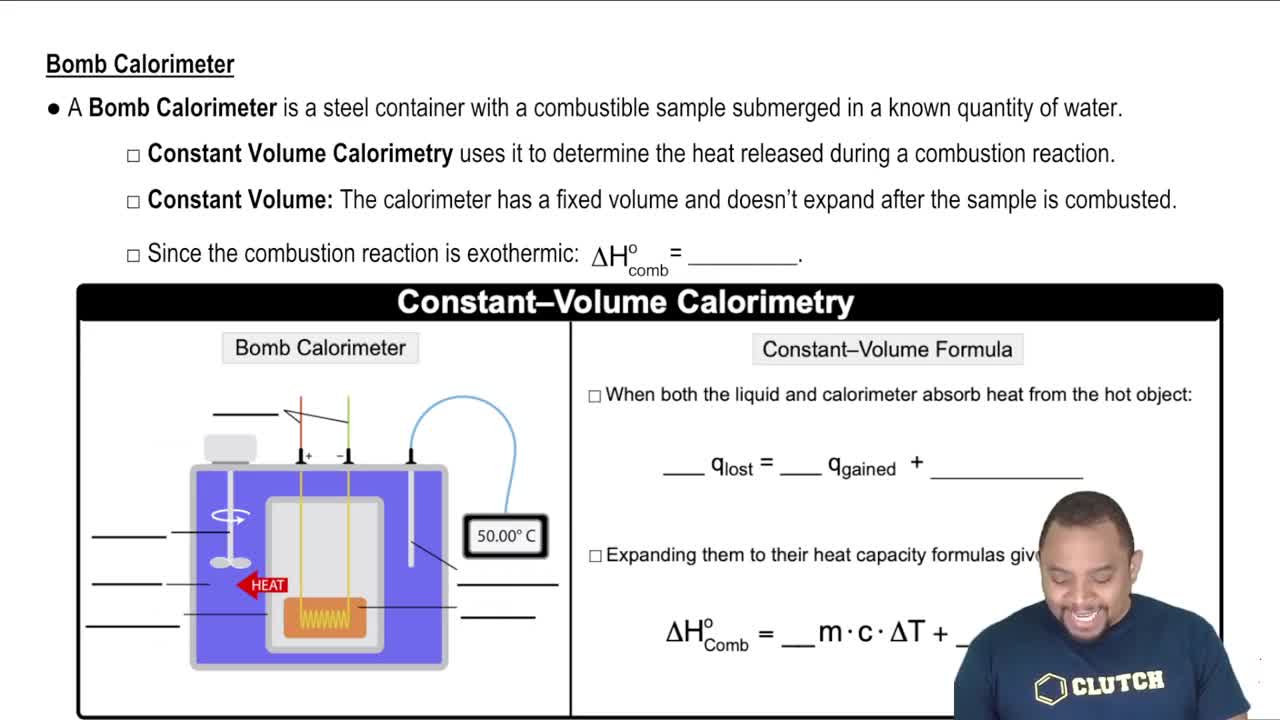
Constant-Volume Calorimetry

Conversion Factors

A conversion factor is a numerical multiplier used to convert a quantity from one unit to another. For example, to convert cubic feet to liters, one must know the equivalent volume of one cubic foot in liters, which is approximately 28.3168 L. Using conversion factors ensures that calculations maintain the correct dimensions and units.
추천 영상:
가이드 코스
01:56
Conversion Factors

Dimensional Analysis

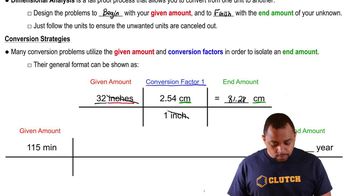
Dimensional analysis is a mathematical technique used to convert between units by multiplying by conversion factors. This method involves canceling out units to ensure that the final result is expressed in the desired unit. It is a powerful tool in chemistry and physics for ensuring that equations and calculations are dimensionally consistent.
추천 영상:
가이드 코스
06:11
Dimensional Analysis