Consider the apparatus shown in the following drawing. (a) When the valve between the two containers is opened and the gases are allowed to mix, what is the partial pressure of N2 after mixing?
Ch.10 - Gases

10장, 문제 62
Consider a mixture of two gases, A and B, confined in a closed vessel. A quantity of a third gas, C, is added to the same vessel at the same temperature. How does the addition of gas C affect the following: (a) the partial pressure of gas A?
검증된 단계별 안내1
Understand the concept of partial pressure: The partial pressure of a gas in a mixture is the pressure that the gas would exert if it occupied the entire volume of the mixture alone.
Recall Dalton's Law of Partial Pressures: The total pressure of a gas mixture is the sum of the partial pressures of each individual gas in the mixture.
Consider the initial state: Initially, gases A and B are in the vessel, each contributing to the total pressure with their respective partial pressures.
Analyze the effect of adding gas C: When gas C is added to the vessel, it increases the total pressure of the system because it contributes its own partial pressure.
Determine the effect on the partial pressure of gas A: The partial pressure of gas A remains unchanged because it depends only on the amount of gas A and the volume and temperature of the vessel, which are constant.

비슷한 문제에 대한 검증된 영상 답변:
이 영상 해법은 위 문제에 도움이 된다고 튜터들이 추천한 것입니다.
영상 길이:
1m주요 개념
질문에 올바르게 답하기 위해 반드시 이해해야 하는 핵심 개념들은 다음과 같습니다.
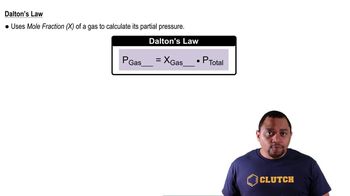
Dalton's Law of Partial Pressures
Dalton's Law states that in a mixture of non-reacting gases, the total pressure exerted is equal to the sum of the partial pressures of each individual gas. Each gas in the mixture behaves independently, and its partial pressure is determined by its mole fraction and the total pressure. This principle is crucial for understanding how the addition of gas C influences the partial pressures of gases A and B.
추천 영상:
가이드 코스
Dalton's Law and Partial Pressure
Ideal Gas Law
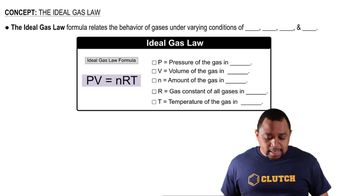
The Ideal Gas Law, expressed as PV = nRT, relates the pressure (P), volume (V), temperature (T), and number of moles (n) of a gas. This law helps predict how changes in the amount of gas, such as adding gas C, will affect the overall pressure and the partial pressures of the other gases in the system. It assumes ideal behavior, which is a good approximation under many conditions.
추천 영상:
가이드 코스
Ideal Gas Law Formula
Mole Fraction
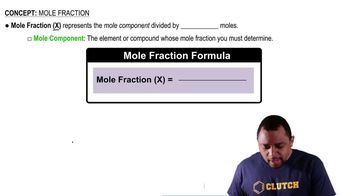
Mole fraction is the ratio of the number of moles of a particular gas to the total number of moles of all gases in the mixture. It is a key factor in calculating partial pressures, as the partial pressure of a gas is directly proportional to its mole fraction in the mixture. Understanding mole fractions is essential for determining how the addition of gas C alters the distribution of pressures among gases A and B.
추천 영상:
가이드 코스
Mole Fraction Formula
관련 실천
교과서 질문
1135
views
교과서 질문
Consider the apparatus shown in the following drawing. (a) When the valve between the two containers is opened and the gases are allowed to mix, how does the volume occupied by the N2 gas change?
683
views
교과서 질문
The atmospheric concentration of CO2 gas is presently 407 ppm (parts per million, by volume; that is, 407 L of every 106 L of the atmosphere are CO2). What is the mole fraction of CO2 in the atmosphere?.
1953
views
교과서 질문
Acetylene gas, C2H2(𝑔), can be prepared by the reaction of calcium carbide with water:
CaC2(𝑠)+2 H2O(𝑙)⟶Ca(OH)2(𝑎𝑞)+C2H2(𝑔)
Calculate the volume of C2H2 that is collected over water at 23°C by reaction of 1.524 g of CaC2 if the total pressure of the gas is 753 torr. (The vapor pressure of water is tabulated in Appendix B.)