Name the phase transition in each of the following situations and indicate whether it is exothermic or endothermic: (d) Molten lava from a volcano turns into solid rock.
Ch.11 - Liquids and Intermolecular Forces

11장, 문제 39b
The boiling points, surface tensions, and viscosities of water and several alcohols are listed in the following table:
b. How do you explain the fact that propanol and ethylene glycol have similar molecular weights (60 vs. 62 amu), yet the viscosity of ethylene glycol is more than 10 times larger than propanol?
검증된 단계별 안내1
Identify the molecular structures of propanol and ethylene glycol. Propanol is C3H7OH, and ethylene glycol is C2H4(OH)2.
Consider the functional groups present in each molecule. Propanol has one hydroxyl group (-OH), while ethylene glycol has two hydroxyl groups.
Understand that the presence of hydroxyl groups leads to hydrogen bonding. Ethylene glycol, with two -OH groups, can form more hydrogen bonds compared to propanol.
Recognize that increased hydrogen bonding in ethylene glycol results in stronger intermolecular forces, which contribute to higher viscosity.
Conclude that despite similar molecular weights, the ability of ethylene glycol to form more hydrogen bonds due to its two hydroxyl groups leads to its significantly higher viscosity compared to propanol.

비슷한 문제에 대한 검증된 영상 답변:
이 영상 해법은 위 문제에 도움이 된다고 튜터들이 추천한 것입니다.
영상 길이:
59s도움이 되었나요?
주요 개념
질문에 올바르게 답하기 위해 반드시 이해해야 하는 핵심 개념들은 다음과 같습니다.
Molecular Weight and Viscosity
Molecular weight is the mass of a molecule, typically measured in atomic mass units (amu). While similar molecular weights can suggest comparable sizes, viscosity is influenced by intermolecular forces and molecular structure. Ethylene glycol, with its two hydroxyl (-OH) groups, forms stronger hydrogen bonds than propanol, leading to higher resistance to flow and thus greater viscosity.
추천 영상:
가이드 코스
Weight Conversion Example
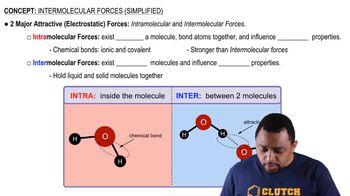
Intermolecular Forces
Intermolecular forces are the attractive forces between molecules that significantly affect physical properties like boiling point and viscosity. Ethylene glycol exhibits stronger hydrogen bonding due to its structure, which increases its viscosity compared to propanol. Understanding these forces helps explain why substances with similar molecular weights can have vastly different physical properties.
추천 영상:
가이드 코스
Intermolecular vs Intramolecular Forces
Hydrogen Bonding
Hydrogen bonding is a specific type of strong dipole-dipole attraction that occurs when hydrogen is bonded to highly electronegative atoms like oxygen. In ethylene glycol, the presence of two -OH groups allows for extensive hydrogen bonding, resulting in a much higher viscosity compared to propanol, which has only one -OH group. This difference in bonding capabilities is crucial for understanding the viscosity disparity.
추천 영상:
가이드 코스
Hydrogenation Reactions
관련 실천
교과서 질문
354
views
교과서 질문
Name the phase transition in each of the following situations and indicate whether it is exothermic or endothermic: (c) Rubbing alcohol in an open container slowly disappears.
356
views
교과서 질문
Based on their composition and structure, list CH2Cl2, CH3CH2CH3, and CH3CH2OH in order of (a) increasing intermolecular forces (c) increasing surface tension
1823
views
교과서 질문
Liquids can interact with flat surfaces just as they can with capillary tubes; the cohesive forces within the liquid can be stronger or weaker than the adhesive forces between liquid and surface:
(b) Which of these diagrams, i or ii, rep- resents what happens when water is on a nonpolar surface?
369
views
교과서 질문
(c) Why do substances with high surface tension also tend to have high viscosities?
2
views