Ch.11 - Liquids and Intermolecular Forces
Brown - Chemistry: The Central Science 15th Edition
Brown15th EditionChemistry: The Central ScienceISBN: 9780137542970당신이 사용하는 게 아니라요?교과서 변경
11장, 문제 35c

(c) Why do substances with high surface tension also tend to have high viscosities?

검증된 단계별 안내
1
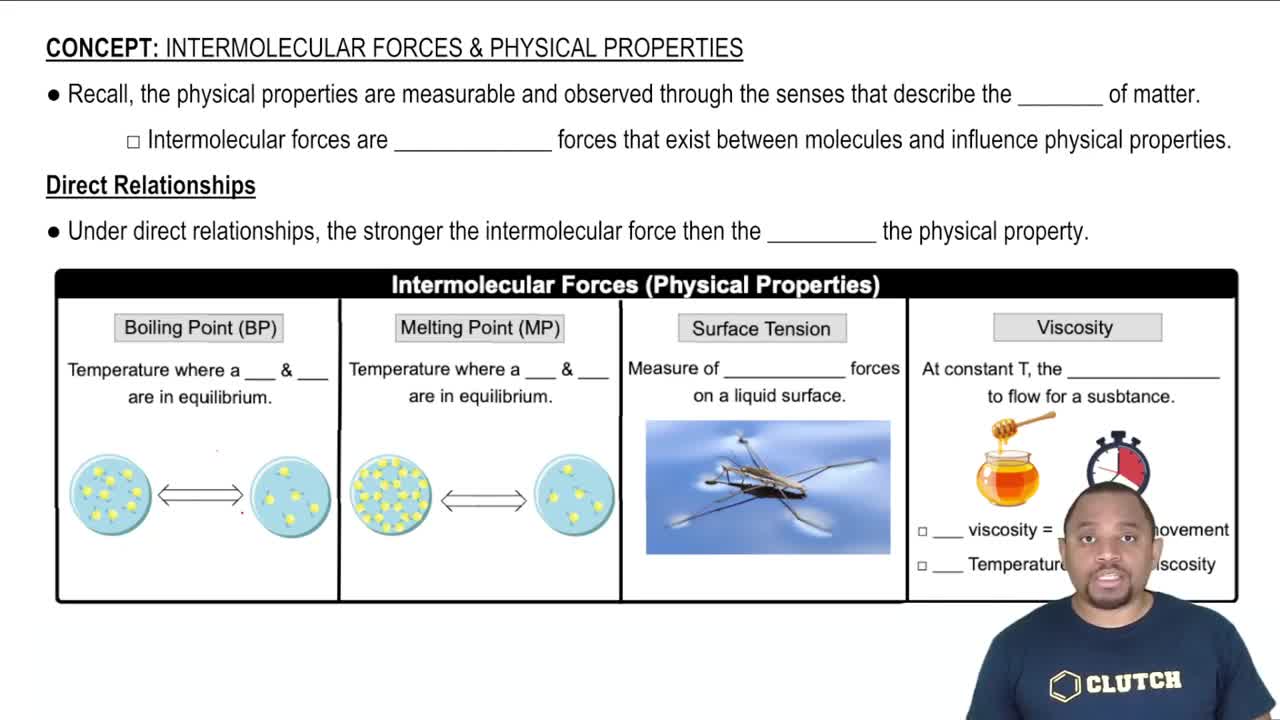
Understand the concept of surface tension: Surface tension is the energy required to increase the surface area of a liquid due to intermolecular forces. It is a measure of how difficult it is to stretch or break the surface of a liquid.
Understand the concept of viscosity: Viscosity is a measure of a fluid's resistance to flow. It describes how thick or sticky a liquid is, which is also influenced by intermolecular forces.
Recognize the role of intermolecular forces: Both surface tension and viscosity are influenced by the strength of intermolecular forces within a liquid. Stronger intermolecular forces lead to higher surface tension and higher viscosity.
Connect surface tension and viscosity: Substances with high surface tension have strong cohesive forces at the surface, which also contribute to the resistance to flow within the liquid, resulting in high viscosity.
Conclude the relationship: Therefore, substances with high surface tension tend to have high viscosities because both properties are dependent on the strength of intermolecular forces within the liquid.

비슷한 문제에 대한 검증된 영상 답변:

이 영상 해법은 위 문제에 도움이 된다고 튜터들이 추천한 것입니다.
영상 길이:
1m
도움이 되었나요?

주요 개념

질문에 올바르게 답하기 위해 반드시 이해해야 하는 핵심 개념들은 다음과 같습니다.

Surface Tension

Surface tension is the cohesive force between liquid molecules at the surface, caused by intermolecular attractions. It results in a 'skin' effect, allowing objects to float or insects to walk on water. Substances with strong intermolecular forces, such as hydrogen bonding, exhibit higher surface tension.
추천 영상:
가이드 코스
03:13
Intermolecular Forces and Properties

Viscosity

Viscosity is a measure of a fluid's resistance to flow, influenced by the internal friction between molecules. Higher viscosity indicates a thicker fluid that flows more slowly. It is affected by temperature and the strength of intermolecular forces; stronger forces lead to higher viscosity.
추천 영상:
가이드 코스
03:13
Intermolecular Forces and Properties

Intermolecular Forces

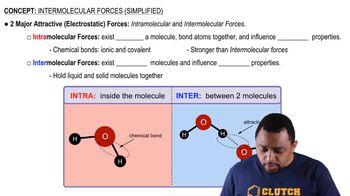
Intermolecular forces are the attractive forces between molecules, including hydrogen bonds, dipole-dipole interactions, and London dispersion forces. Substances with strong intermolecular forces tend to have both high surface tension and high viscosity, as these forces create a more cohesive and resistant liquid structure.
추천 영상:
가이드 코스
01:59
Intermolecular vs Intramolecular Forces
관련 실천
교과서 질문

(b) What is the relationship between viscosity and temperature?

392
views

교과서 질문

A number of salts containing the tetrahedral polyatomic anion, BF4-, are ionic liquids, whereas salts containing the somewhat larger tetrahedral ion SO42- do not form ionic liquids. Explain this observation.

682
views
교과서 질문

The generic structural formula for a 1-alkyl-3-methylimid- azolium cation is where R is a -CH2(CH2)nCH3 alkyl group. The melting points of the salts that form between 1-alkyl-3-methylimidazolium cation and the PF6- anion are as follows: R = CH2CH3 (m.p. = 60 °C), R = CH2CH2CH3 (m.p. = 40 °C), r = CH2CH2CH2CH3 (m.p. = 10 °C), and R = CH2CH2CH2CH2CH2CH3 (m.p. = -61 °C). Why does the melting point decrease as the length of alkyl group increases?

387
views
교과서 질문

The boiling points, surface tensions, and viscosities of water and several alcohols are listed in the following table:

b. How do you explain the fact that propanol and ethylene glycol have similar molecular weights (60 vs. 62 amu), yet the viscosity of ethylene glycol is more than 10 times larger than propanol?

2
views
교과서 질문

Based on their composition and structure, list CH2Cl2, CH3CH2CH3, and CH3CH2OH in order of (a) increasing intermolecular forces (c) increasing surface tension

1823
views
교과서 질문

Liquids can interact with flat surfaces just as they can with capillary tubes; the cohesive forces within the liquid can be stronger or weaker than the adhesive forces between liquid and surface:

(b) Which of these diagrams, i or ii, rep- resents what happens when water is on a nonpolar surface?

369
views