Ch.11 - Liquids and Intermolecular Forces
Brown - Chemistry: The Central Science 15th Edition
Brown15th EditionChemistry: The Central ScienceISBN: 9780137542970당신이 사용하는 게 아니라요?교과서 변경
11장, 문제 3

a. Which of the molecules shown here can form dipole–dipole interactions with other molecules of the same type?
b. Which are capable of forming hydrogen bonds with other molecules of the same type? [Section 11.2]

검증된 단계별 안내
1
Identify the molecular structures of the given molecules and determine if they have polar bonds by checking the electronegativity differences between bonded atoms.
Assess the overall molecular polarity by considering the molecular geometry and the vector sum of the bond dipoles. Molecules with a net dipole moment can engage in dipole-dipole interactions.
For hydrogen bonding, check if the molecule contains hydrogen directly bonded to highly electronegative atoms such as nitrogen, oxygen, or fluorine, which is a prerequisite for hydrogen bonding.
Evaluate the ability of these electronegative atoms to serve as hydrogen bond acceptors by checking if they have lone pairs of electrons, which can interact with hydrogen atoms of other molecules.
Summarize which molecules meet the criteria for dipole-dipole interactions and hydrogen bonding based on the analysis of their molecular structure and bonding.

비슷한 문제에 대한 검증된 영상 답변:

이 영상 해법은 위 문제에 도움이 된다고 튜터들이 추천한 것입니다.
영상 길이:
1m
도움이 되었나요?

주요 개념

질문에 올바르게 답하기 위해 반드시 이해해야 하는 핵심 개념들은 다음과 같습니다.

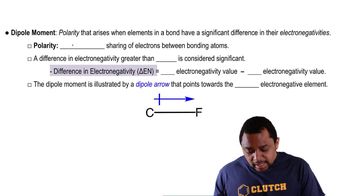
Dipole-Dipole Interactions

Dipole-dipole interactions occur between polar molecules, where the positive end of one molecule is attracted to the negative end of another. These interactions arise due to the uneven distribution of electron density, leading to partial positive and negative charges. Molecules with permanent dipoles can engage in these interactions, which are generally stronger than London dispersion forces but weaker than hydrogen bonds.
추천 영상:

Hydrogen Bonding

Hydrogen bonding is a specific type of dipole-dipole interaction that occurs when hydrogen is covalently bonded to highly electronegative atoms like nitrogen, oxygen, or fluorine. This bond creates a significant dipole, allowing hydrogen to interact strongly with lone pairs of electrons on nearby electronegative atoms. Hydrogen bonds are crucial in determining the properties of substances like water and biological molecules such as DNA.
추천 영상:
가이드 코스
01:22
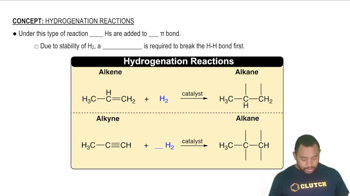
Hydrogenation Reactions

Polarity of Molecules

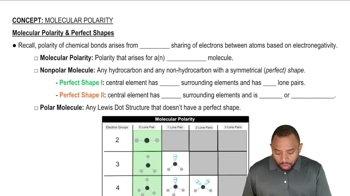
The polarity of a molecule is determined by its shape and the electronegativity of its constituent atoms. A molecule is polar if it has a net dipole moment, meaning that the distribution of electron density is uneven, leading to distinct positive and negative regions. Understanding polarity is essential for predicting the types of intermolecular forces that can occur, including dipole-dipole interactions and hydrogen bonding.
추천 영상:
가이드 코스
02:38
Molecular Polarity