Ch.11 - Liquids and Intermolecular Forces
Brown - Chemistry: The Central Science 15th Edition
Brown15th EditionChemistry: The Central ScienceISBN: 9780137542970당신이 사용하는 게 아니라요?교과서 변경
11장, 문제 7a

Using this graph of CS2 data, determine (a) the approximate vapor pressure of CS2 at 30°C,

검증된 단계별 안내
1
Step 1: Locate the point on the graph that corresponds to a temperature of 30°C. This will be along the x-axis (horizontal axis) of the graph, which typically represents temperature in a vapor pressure graph.
Step 2: From the point at 30°C, draw a line straight up until it intersects with the curve representing the vapor pressure of CS2.
Step 3: Once your line intersects with the curve, draw a line horizontally from that point to the y-axis (vertical axis), which typically represents vapor pressure in a vapor pressure graph.
Step 4: The point where your horizontal line intersects with the y-axis is the approximate vapor pressure of CS2 at 30°C.
Step 5: Read off the value from the y-axis. This is your approximate vapor pressure of CS2 at 30°C. Remember, this is an approximation based on the graph and may not be the exact value.

비슷한 문제에 대한 검증된 영상 답변:

이 영상 해법은 위 문제에 도움이 된다고 튜터들이 추천한 것입니다.
영상 길이:
39s
도움이 되었나요?

주요 개념

질문에 올바르게 답하기 위해 반드시 이해해야 하는 핵심 개념들은 다음과 같습니다.

Vapor Pressure

Vapor pressure is the pressure exerted by a vapor in equilibrium with its liquid or solid phase at a given temperature. It reflects the tendency of particles to escape from the liquid phase into the vapor phase. Higher temperatures generally increase vapor pressure, as more molecules have sufficient energy to overcome intermolecular forces.
추천 영상:
가이드 코스
02:40
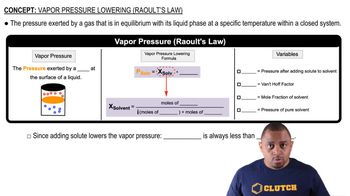
Raoult's Law and Vapor Pressure

Phase Equilibrium

Phase equilibrium occurs when the rates of the forward and reverse processes of a phase change are equal, resulting in no net change in the amount of each phase. In the context of vapor pressure, this means that the number of molecules evaporating from the liquid equals the number condensing back into it, allowing for a stable vapor pressure at a specific temperature.
추천 영상:
가이드 코스
03:22
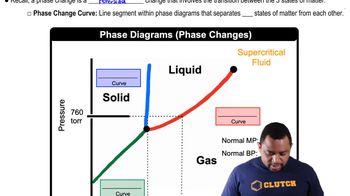
Phase Changes in Diagrams

Temperature Dependence of Vapor Pressure

The vapor pressure of a substance is highly dependent on temperature, typically increasing as temperature rises. This relationship is often described by the Clausius-Clapeyron equation, which relates the change in vapor pressure with temperature to the enthalpy of vaporization. Understanding this concept is crucial for interpreting vapor pressure data at different temperatures.
추천 영상:
가이드 코스
02:40
Raoult's Law and Vapor Pressure
관련 실천
교과서 질문

a. Which of the molecules shown here can form dipole–dipole interactions with other molecules of the same type?

b. Which are capable of forming hydrogen bonds with other molecules of the same type? [Section 11.2]

교과서 질문

The phase diagram of a hypothetical substance is

(b) What is the physical state of the substance under the following conditions? (i) T = 150 K, P = 0.2 atm; (ii) T = 100 K, P = 0.8 atm; (iii) T = 300K, P = 1.0atm. [Section 11.6]

978
views
교과서 질문

The molecules

have the same molecular formula (C3H8O) but different chemical structures. (b) Which molecule do you expect to have a larger dipole moment? [Sections 11.2 and 11.5]

1268
views
교과서 질문

If 42.0 kJ of heat is added to a 32.0-g sample of liquid meth-ane under 1 atm of pressure at a temperature of -170°C, what are the final state and temperature of the methane once the system equilibrates? Assume no heat is lost to the surroundings. The normal boiling point of methane is -161.5 °C. The specific heats of liquid and gaseous methane are 3.48 and 2.22 J/g-K, respectively. [Section 11.4]

3
views
교과서 질문

At three different temperatures, T1, T2, and T3, the molecules in a liquid crystal align in these ways:

(a) At which temperature or temperatures is the substance in a liquid crystalline state? At those temperatures, which type of liquid crystalline phase is depicted?

595
views
1
rank
교과서 질문

(a) Which kind of intermolecular attractive force is shown in each case here? (b) Predict which of the four interactions is the weakest. [Section 11.2]

570
views
1
comments