
Ethylene glycol (HOCH2CH2OH), the major substance in antifreeze, has a normal boiling point of 198 °C. By comparison, ethyl alcohol (CH3CH2OH) boils at 78 °C at atmospheric pressure. Ethylene glycol dimethyl ether (CH3OCH2CH2OCH3) has a normal boiling point of 83 °C, and ethyl methyl ether (CH3CH2OCH3) has a nomral boiling point of 11 °C. (b) What are the major factors responsible for the difference in boiling points of the two ethers?

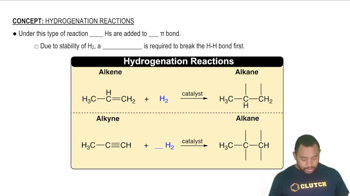
(a) What atoms must a molecule contain to participate in hydrogen bonding with other molecules of the same kind? (b) Which of the following molecules can form hydrogen bonds with other molecules of the same kind: CH3F, CH3NH2, CH3OH, CH3Br?
검증된 단계별 안내
비슷한 문제에 대한 검증된 영상 답변:
주요 개념
Hydrogen Bonding
Electronegativity
Molecular Structure and Polarity
Ethylene glycol (HOCH2CH2OH), the major substance in antifreeze, has a normal boiling point of 198 °C. By comparison, ethyl alcohol (CH3CH2OH) boils at 78 °C at atmospheric pressure. Ethylene glycol dimethyl ether (CH3OCH2CH2OCH3) has a normal boiling point of 83 °C, and ethyl methyl ether (CH3CH2OCH3) has a nomral boiling point of 11 °C. (a) Explain why replacement of a hydrogen on the oxygen by a CH3 group generally results in a lower boiling point.
Which member in each pair has the greater dispersion forces? (b) CO2 or CO, (c) SiH4 or GeH4.
Which member in each pair has the stronger intermolecular dispersion forces? (a) Br2 or O2 (b) CH3CH2CH2CH2SH or CH3CH2CH2CH2CH2SH (c) CH3CH2CH2Cl or (CH3)2CHCl
Which member in each pair has the greater dispersion forces? (a) H2O or H2S,
