Ch.11 - Liquids and Intermolecular Forces
Brown - Chemistry: The Central Science 15th Edition
Brown15th EditionChemistry: The Central ScienceISBN: 9780137542970당신이 사용하는 게 아니라요?교과서 변경
11장, 문제 23a

Which member in each pair has the greater dispersion forces? (a) H2O or H2S,

검증된 단계별 안내
1
Identify the type of intermolecular forces present in each molecule. Both H2O and H2S have dispersion forces, but H2O also has hydrogen bonding due to the presence of highly electronegative oxygen.
Consider the molecular size and molar mass. H2S has a larger molar mass than H2O, which generally leads to stronger dispersion forces.
Evaluate the shape and polarizability of the molecules. Larger and more polarizable molecules tend to have stronger dispersion forces.
Compare the overall intermolecular forces. While H2O has strong hydrogen bonds, the question specifically asks about dispersion forces, which are generally stronger in larger molecules like H2S.
Conclude that H2S, being larger and more polarizable, has greater dispersion forces compared to H2O.

비슷한 문제에 대한 검증된 영상 답변:

이 영상 해법은 위 문제에 도움이 된다고 튜터들이 추천한 것입니다.
영상 길이:
1m
도움이 되었나요?

주요 개념

질문에 올바르게 답하기 위해 반드시 이해해야 하는 핵심 개념들은 다음과 같습니다.

Dispersion Forces

Dispersion forces, also known as London dispersion forces, are weak intermolecular forces arising from temporary fluctuations in electron density within molecules. These fluctuations create instantaneous dipoles that induce dipoles in neighboring molecules, leading to an attractive force. The strength of dispersion forces increases with the size and polarizability of the molecules involved.
추천 영상:
가이드 코스
06:44
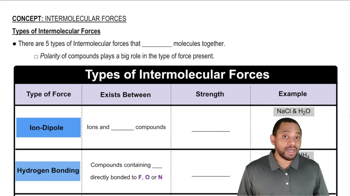
Types of Intermolecular Forces

Molecular Size and Shape

The size and shape of a molecule significantly influence its dispersion forces. Larger molecules have more electrons and a greater surface area, which enhances their polarizability and, consequently, the strength of their dispersion forces. In comparing molecules, those with larger atomic or molecular sizes typically exhibit stronger dispersion forces.
추천 영상:
가이드 코스
02:13
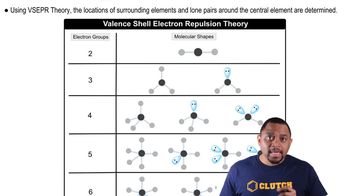
Molecular Shapes and VSEPR

Polarity and Intermolecular Forces

Polarity affects the overall strength of intermolecular forces in a substance. While dispersion forces are present in all molecules, polar molecules like H2O exhibit stronger dipole-dipole interactions compared to nonpolar molecules. Understanding the balance between these forces helps in determining which molecule in a pair has greater dispersion forces, especially when comparing polar and nonpolar substances.
추천 영상:
가이드 코스
01:59
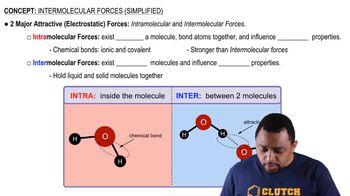
Intermolecular vs Intramolecular Forces