Calculate the number of moles of solute present in each of the following solutions: (a) 255 mL of 1.50 M HNO3(aq),
Ch.13 - Properties of Solutions

13장, 문제 53b
Describe how you would prepare each of the following aqueous solutions from water and solid KBr: b. 125 g of 0.180 m KBr.
검증된 단계별 안내1
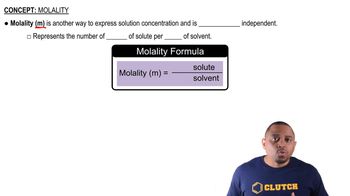
Calculate the moles of KBr needed: Use the formula for molality, \( m = \frac{\text{moles of solute}}{\text{kg of solvent}} \), to find the moles of KBr required.
Determine the mass of water: Since the solution is 125 g, subtract the mass of KBr from 125 g to find the mass of water.
Convert the mass of water to kilograms: This is necessary because molality is defined in terms of kilograms of solvent.
Weigh the calculated mass of KBr: Use a balance to measure the exact mass of KBr needed.
Dissolve the KBr in water: Add the KBr to the calculated mass of water and stir until the KBr is completely dissolved.

비슷한 문제에 대한 검증된 영상 답변:
이 영상 해법은 위 문제에 도움이 된다고 튜터들이 추천한 것입니다.
영상 길이:
3m주요 개념
질문에 올바르게 답하기 위해 반드시 이해해야 하는 핵심 개념들은 다음과 같습니다.
Molarity and Molality
Molarity (M) is a measure of concentration defined as the number of moles of solute per liter of solution, while molality (m) is defined as the number of moles of solute per kilogram of solvent. In this question, the solution is specified in molality, which is important for understanding how to prepare the solution based on the mass of KBr and the mass of water used.
추천 영상:
가이드 코스
Molality
Calculating Moles
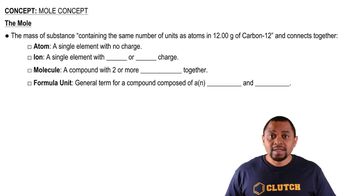
To prepare a solution, it is essential to calculate the number of moles of solute required. The number of moles can be determined using the formula: moles = mass (g) / molar mass (g/mol). For KBr, the molar mass is approximately 119 g/mol, which will be used to convert the mass of KBr into moles for the desired molality.
추천 영상:
가이드 코스
Mole Concept
Solution Preparation
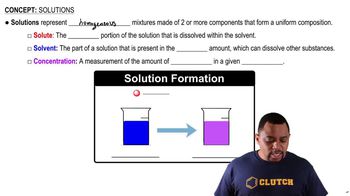
Preparing a solution involves dissolving a calculated amount of solute in a specific amount of solvent. For a 0.180 m KBr solution, you would need to dissolve the calculated moles of KBr in enough water to achieve the desired molality, ensuring that the total mass of the solvent is accurate. This process requires careful measurement and mixing to ensure uniformity.
추천 영상:
가이드 코스
Solution Components
관련 실천
교과서 질문
1422
views
교과서 질문
Brass is a substitutional alloy consisting of a solution of copper and zinc. A particular sample of red brass consisting of 80.0 % Cu and 20.0 % Zn by mass has a density of 8750 kg/m3. (a) What is the molality of Zn in the solid solution?
1945
views
교과서 질문
Describe how you would prepare each of the following aqueous solutions from water and the solid solute: a. 1.50 L of 0.110 M (NH4)2SO4 solution;
교과서 질문
Commercial aqueous nitric acid has a density of 1.42 g/mL and is 16 M. Calculate the percent HNO3 by mass in the solution.
2791
views
1
comments
교과서 질문
Calculate the number of moles of solute present in each of the following aqueous solutions: (c) 124.0 g of a solution that is 6.45% glucose (C6H12O6) by mass.
1016
views