Ch.13 - Properties of Solutions
Brown - Chemistry: The Central Science 15th Edition
Brown15th EditionChemistry: The Central ScienceISBN: 9780137542970당신이 사용하는 게 아니라요?교과서 변경
13장, 문제 15a

Indicate the type of solute–solvent interaction that should be most important in each of the following solutions: a. CCl4 in benzene (C6H6),

검증된 단계별 안내
1
Identify the polarity of the solute (CCl4) and the solvent (benzene, C6H6). Both CCl4 and benzene are nonpolar molecules.
Understand that nonpolar molecules have London dispersion forces as the primary type of intermolecular force.
Recognize that when both solute and solvent are nonpolar, the interaction between them is primarily through dispersion forces.
Conclude that the most important type of solute-solvent interaction in a solution of CCl4 in benzene is dispersion forces.
Consider that these interactions facilitate the dissolution of CCl4 in benzene, as like dissolves like, meaning nonpolar solutes tend to dissolve well in nonpolar solvents.

비슷한 문제에 대한 검증된 영상 답변:

이 영상 해법은 위 문제에 도움이 된다고 튜터들이 추천한 것입니다.
영상 길이:
1m
도움이 되었나요?

주요 개념

질문에 올바르게 답하기 위해 반드시 이해해야 하는 핵심 개념들은 다음과 같습니다.

Solute-Solvent Interactions

Solute-solvent interactions refer to the forces that occur between solute particles and solvent molecules when a solution is formed. These interactions can include hydrogen bonding, dipole-dipole interactions, and London dispersion forces. The type of interaction that predominates depends on the nature of the solute and solvent, influencing solubility and solution properties.
추천 영상:
가이드 코스
01:39
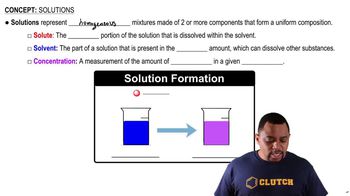
Solution Components

Polarity

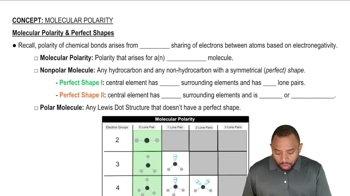
Polarity is a key concept in chemistry that describes the distribution of electrical charge over the atoms in a molecule. Polar molecules have a significant difference in electronegativity between their atoms, leading to partial positive and negative charges. In contrast, nonpolar molecules, like CCl4, have an even distribution of charge, which affects their interactions with polar and nonpolar solvents.
추천 영상:
가이드 코스
02:38
Molecular Polarity

Like Dissolves Like

The principle of 'like dissolves like' states that polar solvents tend to dissolve polar solutes, while nonpolar solvents dissolve nonpolar solutes. This concept is crucial for predicting solubility and understanding the behavior of mixtures. In the case of CCl4 in benzene, both are nonpolar, suggesting that London dispersion forces will be the primary interaction facilitating their solubility.
추천 영상:
가이드 코스
02:14
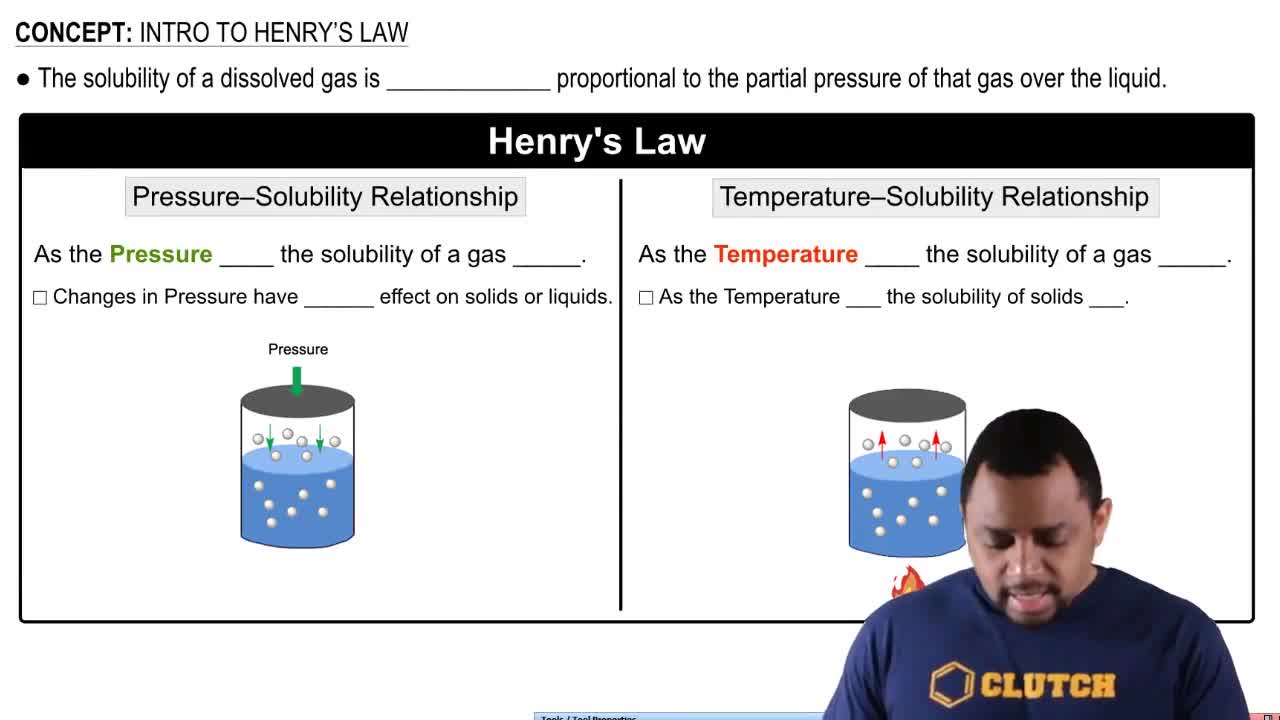
Henry's Law Solubility