Ch.13 - Properties of Solutions
Brown - Chemistry: The Central Science 15th Edition
Brown15th EditionChemistry: The Central ScienceISBN: 9780137542970당신이 사용하는 게 아니라요?교과서 변경
13장, 문제 15d

Indicate the type of solute–solvent interaction that should be most important in each of the following solutions: d. HCl in acetonitrile (CH3CN).

검증된 단계별 안내
1
Identify the nature of the solute and solvent in the solution. Here, the solute is hydrochloric acid (HCl), which is a polar molecule, and the solvent is acetonitrile (CH3CN), which is also a polar molecule.
Understand the types of intermolecular forces that can occur between solute and solvent. The primary forces include hydrogen bonding, dipole-dipole interactions, and dispersion forces.
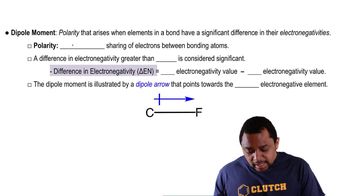
Analyze the molecular structure of HCl and CH3CN to determine the possible interactions. HCl has a hydrogen atom bonded to a chlorine atom, creating a significant dipole. Acetonitrile has a triple bond between carbon and nitrogen, which also creates a dipole.
Determine the most likely interaction based on the molecular structures. Since both HCl and CH3CN are polar, the primary interaction is likely to be dipole-dipole interactions.
Conclude that the most important solute-solvent interaction in a solution of HCl in acetonitrile is dipole-dipole interaction, due to the polar nature of both the solute and the solvent.

비슷한 문제에 대한 검증된 영상 답변:

이 영상 해법은 위 문제에 도움이 된다고 튜터들이 추천한 것입니다.
영상 길이:
1m
도움이 되었나요?

주요 개념

질문에 올바르게 답하기 위해 반드시 이해해야 하는 핵심 개념들은 다음과 같습니다.

Solute-Solvent Interactions

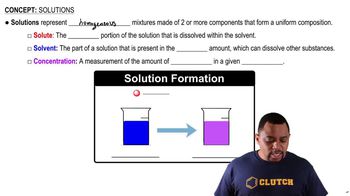
Solute-solvent interactions refer to the various forces that occur between solute particles and solvent molecules when a solution is formed. These interactions can include hydrogen bonding, dipole-dipole interactions, and ion-dipole interactions, which significantly influence the solubility and behavior of solutes in solvents.
추천 영상:
가이드 코스
01:39
Solution Components

Acetonitrile as a Solvent

Acetonitrile (CH₃CN) is a polar aprotic solvent, meaning it has a significant dipole moment but lacks hydrogen atoms that can participate in hydrogen bonding. This property allows it to solvate cations effectively through dipole-dipole interactions, making it suitable for dissolving ionic and polar solutes like HCl.
추천 영상:
가이드 코스
02:40
Raoult's Law and Vapor Pressure

Ion-Dipole Interactions

Ion-dipole interactions occur when an ion interacts with the polar molecules of a solvent. In the case of HCl in acetonitrile, the H⁺ ion from HCl will interact strongly with the dipole of acetonitrile, leading to effective solvation. This interaction is crucial for understanding the behavior of strong acids in polar solvents.
추천 영상: