Ch.13 - Properties of Solutions
Brown - Chemistry: The Central Science 15th Edition
Brown15th EditionChemistry: The Central ScienceISBN: 9780137542970당신이 사용하는 게 아니라요?교과서 변경
13장, 문제 76

Using data from Table 13.3, calculate the freezing and boiling points of each of the following solutions: (a) 0.25 m glucose in ethanol; (b) 20.0 g of decane, C10H22, in 50.0 g CHCl3; (c) 3.50 g NaOH in 175 g of water, (d) 0.45 mol ethylene glycol and 0.15 mol KBr in 150 g H2O.

검증된 단계별 안내
1
Identify the solute and solvent in the solution. Here, decane (C_{10}H_{22}) is the solute, and chloroform (CHCl_{3}) is the solvent.
Calculate the molality (m) of the solution using the formula: \( m = \frac{\text{moles of solute}}{\text{kilograms of solvent}} \). First, find the moles of decane by dividing its mass by its molar mass.
Use the freezing point depression formula: \( \Delta T_f = i \cdot K_f \cdot m \), where \( i \) is the van't Hoff factor (which is 1 for non-electrolytes like decane), \( K_f \) is the freezing point depression constant for chloroform, and \( m \) is the molality calculated in the previous step.
Calculate the new freezing point by subtracting \( \Delta T_f \) from the normal freezing point of chloroform.
Use the boiling point elevation formula: \( \Delta T_b = i \cdot K_b \cdot m \), where \( K_b \) is the boiling point elevation constant for chloroform. Calculate the new boiling point by adding \( \Delta T_b \) to the normal boiling point of chloroform.

비슷한 문제에 대한 검증된 영상 답변:

이 영상 해법은 위 문제에 도움이 된다고 튜터들이 추천한 것입니다.
영상 길이:
3m

주요 개념

질문에 올바르게 답하기 위해 반드시 이해해야 하는 핵심 개념들은 다음과 같습니다.

Colligative Properties

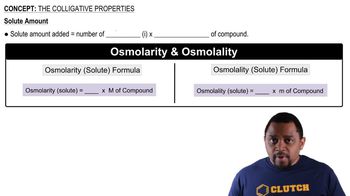
Colligative properties are physical properties of solutions that depend on the number of solute particles in a given amount of solvent, rather than the identity of the solute. These properties include boiling point elevation and freezing point depression, which are crucial for understanding how the addition of a solute, like decane, affects the phase changes of the solvent, in this case, chloroform.
추천 영상:
가이드 코스
01:26
Colligative Properties

Boiling Point Elevation

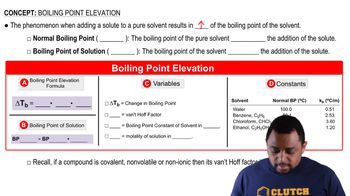
Boiling point elevation is a colligative property that describes how the boiling point of a solvent increases when a non-volatile solute is added. The extent of this elevation can be calculated using the formula ΔT_b = i * K_b * m, where ΔT_b is the change in boiling point, K_b is the ebullioscopic constant of the solvent, and m is the molality of the solution. Understanding this concept is essential for calculating the new boiling point of the chloroform solution.
추천 영상:
가이드 코스
03:05
Boiling Point Elevation

Freezing Point Depression

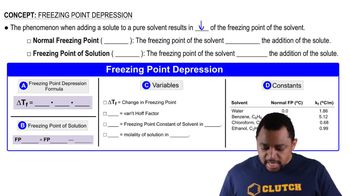
Freezing point depression is another colligative property that indicates how the freezing point of a solvent decreases when a solute is added. This can be calculated using the formula ΔT_f = i * K_f * m, where ΔT_f is the change in freezing point, K_f is the cryoscopic constant of the solvent, and m is the molality. This concept is vital for determining how the addition of decane will lower the freezing point of chloroform.
추천 영상:
가이드 코스
01:59
Freezing Point Depression