
Ch.14 - Chemical Kinetics
Brown - Chemistry: The Central Science 15th Edition
Brown15th EditionChemistry: The Central ScienceISBN: 9780137542970당신이 사용하는 게 아니라요?교과서 변경
14장, 문제 12d

Consider the diagram that follows, which represents two steps in an overall reaction. The red spheres are oxygen, the blue ones are nitrogen, and the green ones are fluorine. d. Write the rate law for the overall reaction if the first step is the slow, rate-determining step. [Section 14.5]

검증된 단계별 안내
1
Identify the reactants involved in the slow, rate-determining step.
Determine the molecularity of the slow step by counting the number of reactant molecules involved.
Write the rate law based on the molecularity of the slow step, using the concentrations of the reactants.
Express the rate law in the form: rate = k [A]^m [B]^n, where A and B are reactants, and m and n are their respective orders.
Remember that the rate law for the overall reaction is determined by the rate law of the slowest step in the mechanism.

비슷한 문제에 대한 검증된 영상 답변:

이 영상 해법은 위 문제에 도움이 된다고 튜터들이 추천한 것입니다.
영상 길이:
2m
도움이 되었나요?

주요 개념

질문에 올바르게 답하기 위해 반드시 이해해야 하는 핵심 개념들은 다음과 같습니다.

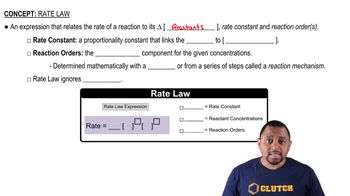
Rate Law

The rate law is an equation that relates the rate of a chemical reaction to the concentration of its reactants. It is typically expressed in the form rate = k[A]^m[B]^n, where k is the rate constant, [A] and [B] are the concentrations of the reactants, and m and n are the reaction orders. Understanding the rate law is crucial for predicting how changes in concentration affect the reaction rate.
추천 영상:
가이드 코스
01:52
Rate Law Fundamentals

Rate-Determining Step

The rate-determining step is the slowest step in a multi-step reaction mechanism, which limits the overall reaction rate. This step dictates the kinetics of the entire reaction, and its rate law can be used to derive the overall rate law. Identifying the rate-determining step is essential for accurately writing the rate law for complex reactions.
추천 영상:
가이드 코스
01:15
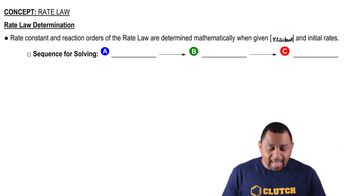
Rate Law Determination

Reaction Mechanism

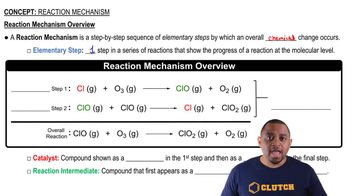
A reaction mechanism is a detailed description of the individual steps that occur during a chemical reaction. Each step involves the breaking and forming of bonds, and the mechanism provides insight into how reactants are converted into products. Understanding the mechanism is vital for determining which step is rate-determining and for writing the correct rate law.
추천 영상:
가이드 코스
03:06
Reaction Mechanism Overview