
Ch.14 - Chemical Kinetics
Brown - Chemistry: The Central Science 15th Edition
Brown15th EditionChemistry: The Central ScienceISBN: 9780137542970당신이 사용하는 게 아니라요?교과서 변경
14장, 문제 39a

(a) For the generic reaction A → B what quantity, when graphed versus time, will yield a straight line for a first-order reaction?

검증된 단계별 안내
1
Identify the order of the reaction given in the problem, which is a first-order reaction.
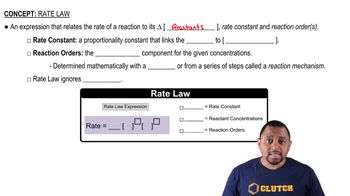
Recall that for a first-order reaction, the rate of reaction is directly proportional to the concentration of one reactant. The rate law can be expressed as: \(rate = k[A]\), where \(k\) is the rate constant and \([A]\) is the concentration of reactant A.
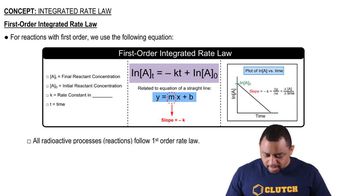
Understand that for a first-order reaction, the natural logarithm of the concentration of the reactant versus time will yield a straight line. This is derived from the integrated rate law for a first-order reaction: \(\ln[A] = -kt + \ln[A]_0\), where \([A]_0\) is the initial concentration of A.
Set up the graph with time (t) on the x-axis and the natural logarithm of the concentration of A (\(\ln[A]\)) on the y-axis.
Plot the data points for \(\ln[A]\) versus time and draw the best fit line. The slope of this line will be equal to \(-k\), and the y-intercept will be \(\ln[A]_0\).

비슷한 문제에 대한 검증된 영상 답변:

이 영상 해법은 위 문제에 도움이 된다고 튜터들이 추천한 것입니다.
영상 길이:
1m
도움이 되었나요?

주요 개념

질문에 올바르게 답하기 위해 반드시 이해해야 하는 핵심 개념들은 다음과 같습니다.

First-Order Reactions

First-order reactions are chemical reactions where the rate is directly proportional to the concentration of one reactant. This means that as the concentration of the reactant decreases, the rate of reaction also decreases in a linear fashion. The mathematical representation of a first-order reaction is given by the equation: rate = k[A], where k is the rate constant and [A] is the concentration of reactant A.
추천 영상:
가이드 코스
02:29
First-Order Reactions

Integrated Rate Law

The integrated rate law for a first-order reaction relates the concentration of the reactant to time. It is expressed as ln[A] = -kt + ln[A]₀, where [A]₀ is the initial concentration, k is the rate constant, and t is time. When plotted, a graph of ln[A] versus time yields a straight line with a slope of -k, indicating that the reaction follows first-order kinetics.
추천 영상:
가이드 코스
01:52
Rate Law Fundamentals

Graphing Reaction Kinetics

Graphing is a crucial tool in analyzing reaction kinetics. For first-order reactions, plotting the natural logarithm of the concentration of the reactant (ln[A]) against time results in a straight line. This linear relationship allows chemists to determine the rate constant (k) and understand the reaction's behavior over time, providing insights into the reaction mechanism and dynamics.
추천 영상:
가이드 코스
03:06
Chemical Kinetics