
As described in Exercise 14.41, the decomposition of sulfuryl chloride (SO2Cl2) is a first-order process. The rate constant for the decomposition at 660 K is 4.5 × 10⁻² s-1. (b) At what time will the partial pressure of SO2Cl2 decline to one-tenth its initial value?
Ch.14 - Chemical Kinetics

14장, 문제 41b
(b) At 320°C the rate constant is 2.2 × 10⁻⁵ s-1. What is the half-life at this temperature?
검증된 단계별 안내1
Identify the type of reaction. Since the rate constant is given in s-1, this suggests a first-order reaction.
Recall the formula for the half-life of a first-order reaction: , where is the rate constant.
Substitute the given rate constant value into the formula: .
Perform the division to calculate the half-life: divide 0.693 by the rate constant value.
The result from the division will give you the half-life of the reaction at 320°C.

비슷한 문제에 대한 검증된 영상 답변:
이 영상 해법은 위 문제에 도움이 된다고 튜터들이 추천한 것입니다.
영상 길이:
1m주요 개념
질문에 올바르게 답하기 위해 반드시 이해해야 하는 핵심 개념들은 다음과 같습니다.
Rate Constant
The rate constant (k) is a proportionality factor in the rate equation of a chemical reaction, indicating the speed of the reaction at a given temperature. It is specific to the reaction and varies with temperature, reflecting how the frequency of effective collisions between reactants changes. In this case, the rate constant is given as 2.2 × 10<sup>-5</sup> s<sup>-1</sup>, which is essential for calculating the half-life.
추천 영상:
가이드 코스
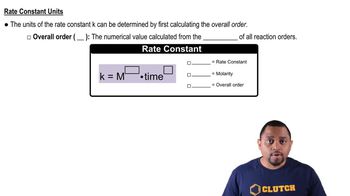
Rate Constant Units
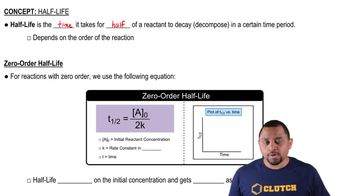
Half-Life
Half-life is the time required for the concentration of a reactant to decrease to half of its initial value. For first-order reactions, the half-life is inversely proportional to the rate constant, allowing for straightforward calculations. The formula for half-life (t<sub>1/2</sub>) in first-order kinetics is t<sub>1/2</sub> = 0.693/k, where k is the rate constant.
추천 영상:
가이드 코스
Zero-Order Half-life
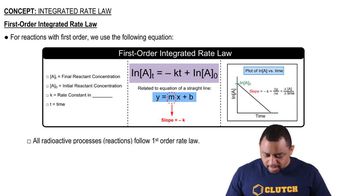
First-Order Kinetics
First-order kinetics describes a reaction where the rate is directly proportional to the concentration of one reactant. This means that as the concentration decreases, the rate of reaction also decreases. The relationship between the rate constant and half-life in first-order reactions simplifies calculations, making it easier to determine how long it takes for a substance to reduce to half its amount.
추천 영상:
가이드 코스
First-Order Reactions
관련 실천
교과서 질문
1755
views
교과서 질문
(a) The gas-phase decomposition of SO2Cl2, SO2Cl2(g) → SO2(g) + Cl2(g), is first order in SO2Cl2. At 600 K the half-life for this process is 2.3 × 10⁵ s. What is the rate constant at this temperature?
1430
views
교과서 질문
As described in Exercise 14.41, the decomposition of sulfuryl chloride (SO2Cl2) is a first-order process. The rate constant for the decomposition at 660 K is 4.5 × 10⁻² s-1. (a) If we begin with an initial SO2Cl2 pressure of 450 torr, what is the partial pressure of this substance after 60 s?
교과서 질문
(a) For the generic reaction A → B what quantity, when graphed versus time, will yield a straight line for a first-order reaction?
628
views
교과서 질문
(b) How can you calculate the rate constant for a first-order reaction from the graph you made in part (a)?
