
Ch.14 - Chemical Kinetics
Brown - Chemistry: The Central Science 15th Edition
Brown15th EditionChemistry: The Central ScienceISBN: 9780137542970당신이 사용하는 게 아니라요?교과서 변경
14장, 문제 36

The following data were collected for the rate of disappearance of NO in the reaction 2 NO(g) + O2(g) → 2 NO2(g): Experiment [NO] (M) [O2] (M) Initial Rate (M/s) 1 0.0126 0.0125 1.41 * 10^-2 2 0.0252 0.0125 5.64 * 10^-2 3 0.0252 0.0250 1.13 * 10^-1 (d) What is the rate of disappearance of NO when [NO] = 0.0750 M and [O2] = 0.0100 M? (e) What is the rate of disappearance of O2 at the concentrations given in part (d)?

검증된 단계별 안내
1
Step 1: Determine the rate law for the reaction. The rate law can be expressed as Rate = k[NO]^m[O2]^n, where k is the rate constant, and m and n are the orders of the reaction with respect to NO and O2, respectively.
Step 2: Use the experimental data to find the reaction orders m and n. Compare experiments 1 and 2 to find m, keeping [O2] constant, and compare experiments 2 and 3 to find n, keeping [NO] constant.
Step 3: Calculate the rate constant k using the rate law and the data from one of the experiments, now that m and n are known.
Step 4: Use the rate law with the calculated k, and the given concentrations [NO] = 0.0750 M and [O2] = 0.0100 M to find the rate of disappearance of NO.
Step 5: Use the stoichiometry of the reaction to find the rate of disappearance of O2. Since the reaction is 2 NO + O2 → 2 NO2, the rate of disappearance of O2 is half the rate of disappearance of NO.

주요 개념

질문에 올바르게 답하기 위해 반드시 이해해야 하는 핵심 개념들은 다음과 같습니다.

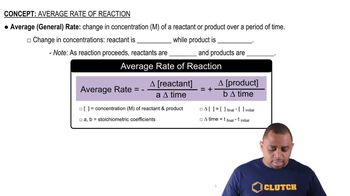
Rate of Reaction

The rate of reaction refers to the speed at which reactants are converted into products in a chemical reaction. It is typically expressed in terms of the change in concentration of a reactant or product per unit time, often in units of M/s. Understanding how the concentration of reactants affects the rate is crucial for predicting reaction behavior under different conditions.
추천 영상:
가이드 코스
02:03
Average Rate of Reaction

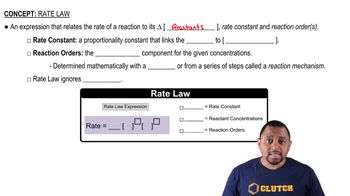
Rate Law

The rate law is an equation that relates the rate of a reaction to the concentration of its reactants, typically expressed as rate = k [A]^m [B]^n, where k is the rate constant, and m and n are the reaction orders with respect to each reactant. Determining the rate law from experimental data allows chemists to understand the relationship between concentration and reaction rate, which is essential for solving the given problem.
추천 영상:
가이드 코스
01:52
Rate Law Fundamentals

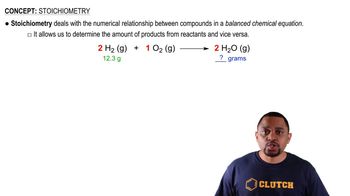
Stoichiometry

Stoichiometry involves the calculation of reactants and products in chemical reactions based on the balanced chemical equation. In the context of the given reaction, it helps in determining the relationship between the rates of disappearance of NO and O2, as well as their concentrations. This concept is vital for converting the rate of disappearance of one reactant into that of another using the coefficients from the balanced equation.
추천 영상:
가이드 코스
01:16
Stoichiometry Concept
관련 실천
교과서 질문

Consider the reaction of peroxydisulfate ion (S2O82-) with iodide ion (I-) in aqueous solution:

S2O82-(aq) + 3 I-(aq) → 2 SO42-(aq) + I3-(aq)

 At a particular temperature, the initial rate of disappearance of S2O82- varies with reactant concentrations in the following manner:

Experiment [S2O82-] (M) [I-] (M) Initial Rate (M/s)

1 0.018 0.036 2.6 × 10⁻⁶

2 0.027 0.036 3.9 × 10⁻⁶

3 0.036 0.054 7.8 × 10⁻⁶

4 0.050 0.072 1.4 × 10⁻⁵

(a) Determine the rate law for the reaction and state the units of the rate constant.

2175
views
교과서 질문

The following data were measured for the reaction BF3(g) + NH3(g) → F3BNH3(g):

Experiment [BF3] (M) [NH3] (M) Initial Rate (M/s)

1 0.250 0.250 0.2130

2 0.250 0.125 0.1065

3 0.200 0.100 0.0682

4 0.350 0.100 0.1193

5 0.175 0.100 0.0596 

(c) Calculate the rate constant with proper units?

704
views
교과서 질문

The following data were measured for the reaction BF3(g) + NH3(g) → F3BNH3(g):

Experiment [BF3] (M) [NH3] (M) Initial Rate (M/s)

1 0.250 0.250 0.2130

2 0.250 0.125 0.1065

3 0.200 0.100 0.0682

4 0.350 0.100 0.1193

5 0.175 0.100 0.0596 

(b) What is the overall order of the reaction?

813
views
교과서 질문

(a) For the generic reaction A → B what quantity, when graphed versus time, will yield a straight line for a first-order reaction?

628
views
교과서 질문

The following data were measured for the reaction BF3(g) + NH3(g) → F3BNH3(g):

Experiment [BF3] (M) [NH3] (M) Initial Rate (M/s)

1 0.250 0.250 0.2130

2 0.250 0.125 0.1065

3 0.200 0.100 0.0682

4 0.350 0.100 0.1193

5 0.175 0.100 0.0596

(d) What is the rate when [BF3] = 0.100 M and [NH3] = 0.500 M?

교과서 질문

Consider the gas-phase reaction between nitric oxide and bromine at 273°C: 2 NO(g) + Br2(g) → 2 NOBr(g). The following data for the initial rate of appearance of NOBr were obtained:

Experiment [NO] (M) [Br2] (M) Initial Rate (M/s)

1 0.10 0.20 24

2 0.25 0.20 150

3 0.10 0.50 60

4 0.35 0.50 735 

(b) Calculate the average value of the rate constant for the appearance of NOBr from the four data sets.

1004
views