
Which, if any, of the following statements are true? (a) The stronger the base, the smaller the pKb. (b) The stronger the base, the larger the pKb. (c) The stronger the base, the smaller the Kb. (d) The stronger the base, the larger the Kb. (e) The stronger the base, the smaller the pKa of its conjugate acid. (f) The stronger the base, the larger the pKa of its conjugate acid.
Ch.16 - Acid-Base Equilibria

16장, 문제 103
Calculate the pH of a solution made by adding 2.50 g of lithium oxide 1Li2O2 to enough water to make 1.500 L of solution.
검증된 단계별 안내1
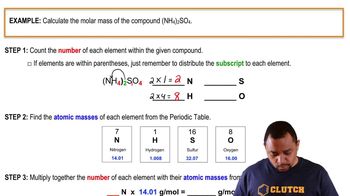
Determine the molar mass of lithium oxide (Li2O). Calculate it by adding the atomic masses of lithium (Li) and oxygen (O) from the periodic table.
Convert the mass of lithium oxide (2.50 g) to moles using the molar mass calculated in the previous step.
Write the balanced chemical equation for the reaction of lithium oxide with water. Li2O reacts with water to form lithium hydroxide (LiOH).
Calculate the concentration of lithium hydroxide (LiOH) in the solution by dividing the moles of LiOH by the volume of the solution in liters (1.500 L).
Use the concentration of LiOH to find the pH. Since LiOH is a strong base, it dissociates completely in water, and the concentration of OH- ions is equal to the concentration of LiOH. Calculate the pOH and then use the relation pH + pOH = 14 to find the pH.

비슷한 문제에 대한 검증된 영상 답변:
이 영상 해법은 위 문제에 도움이 된다고 튜터들이 추천한 것입니다.
영상 길이:
4m도움이 되었나요?
주요 개념
질문에 올바르게 답하기 위해 반드시 이해해야 하는 핵심 개념들은 다음과 같습니다.
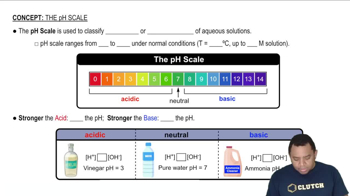
pH Scale
The pH scale measures the acidity or basicity of a solution, ranging from 0 to 14. A pH of 7 is considered neutral, while values below 7 indicate acidity and values above 7 indicate basicity. The pH is calculated as the negative logarithm of the hydrogen ion concentration in the solution, which is crucial for understanding the solution's chemical behavior.
추천 영상:
가이드 코스
The pH Scale
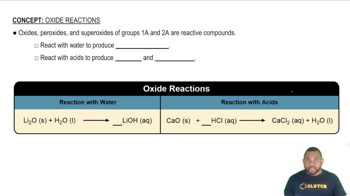
Lithium Oxide (Li2O) Dissociation
Lithium oxide is a basic oxide that reacts with water to form lithium hydroxide (LiOH). This reaction increases the concentration of hydroxide ions (OH-) in the solution, which in turn affects the pH. Understanding this dissociation is essential for calculating the resulting pH after the oxide is dissolved in water.
추천 영상:
가이드 코스
Oxide Reactions
Molarity and Concentration Calculations
Molarity is a measure of concentration defined as the number of moles of solute per liter of solution. To calculate the pH, one must first determine the number of moles of lithium oxide in the given mass and then find the concentration of hydroxide ions produced in the solution. This step is critical for accurately determining the pH of the resulting solution.
추천 영상:
가이드 코스
Molar Mass Calculation Example
관련 실천
교과서 질문
1825
views
교과서 질문
Predict how each molecule or ion would act, in the Brønsted-Lowry sense, in aqueous solution by writing 'acid,' 'base,' 'both,' or 'neither' on the line provided. (b) Prozac
408
views
교과서 질문
A solution is made by adding 0.300 g Ca1OH221s2, 50.0 mL of 1.40 M HNO3, and enough water to make a final volume of 75.0 mL. Assuming that all of the solid dissolves, what is the pH of the final solution?
1014
views
