Ch.19 - Chemical Thermodynamics
Brown - Chemistry: The Central Science 15th Edition
Brown15th EditionChemistry: The Central ScienceISBN: 9780137542970당신이 사용하는 게 아니라요?교과서 변경
19장, 문제 26b

(b) In a particular spontaneous process the entropy of the system decreases. What can you conclude about the sign and magnitude of ΔSsurr?

검증된 단계별 안내
1
Identify the given information: The entropy of the system (ΔSsys) decreases, which means ΔSsys is negative.
Recall the second law of thermodynamics, which states that for a spontaneous process, the total entropy change of the universe (ΔSuniv) must be positive, i.e., ΔSuniv = ΔSsys + ΔSsurr > 0.
Since ΔSsys is negative, ΔSsurr must be positive to ensure that the sum (ΔSuniv) is positive for the process to be spontaneous.
Determine that the magnitude of ΔSsurr must be greater than the magnitude of ΔSsys to compensate for the negative ΔSsys and still achieve a positive ΔSuniv.
Conclude that ΔSsurr is positive and its magnitude is greater than the magnitude of the negative ΔSsys.

비슷한 문제에 대한 검증된 영상 답변:

이 영상 해법은 위 문제에 도움이 된다고 튜터들이 추천한 것입니다.
영상 길이:
56s

주요 개념

질문에 올바르게 답하기 위해 반드시 이해해야 하는 핵심 개념들은 다음과 같습니다.

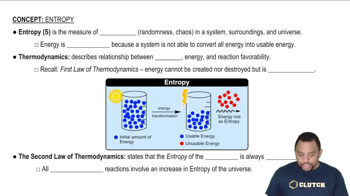
Entropy (S)

Entropy is a measure of the disorder or randomness in a system. In thermodynamics, it quantifies the number of ways a system can be arranged, with higher entropy indicating greater disorder. For spontaneous processes, the second law of thermodynamics states that the total entropy of an isolated system must increase over time, which is crucial for understanding the behavior of systems in nature.
추천 영상:
가이드 코스
02:46
Entropy in Thermodynamics

Second Law of Thermodynamics

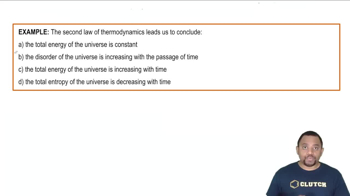
The second law of thermodynamics states that in any spontaneous process, the total entropy of the universe (system plus surroundings) must increase. This principle implies that if the entropy of a system decreases, the entropy of the surroundings must increase by a greater amount to ensure that the overall entropy change is positive, thus driving the spontaneity of the process.
추천 영상:
가이드 코스
00:48
Second Law of Thermodynamics Example

Gibbs Free Energy (ΔG)

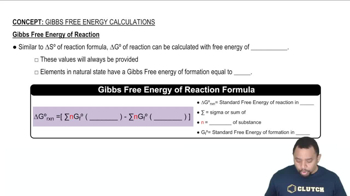
Gibbs free energy is a thermodynamic potential that measures the maximum reversible work obtainable from a system at constant temperature and pressure. It is defined as ΔG = ΔH - TΔS, where ΔH is the change in enthalpy, T is the temperature in Kelvin, and ΔS is the change in entropy. A negative ΔG indicates a spontaneous process, linking the concepts of entropy and energy changes in chemical reactions.
추천 영상:
가이드 코스
01:51
Gibbs Free Energy of Reactions
관련 실천
교과서 질문

Indicate whether each statement is true or false. (c) In a certain spontaneous process the system undergoes an entropy change of 4.2 J/K; therefore, the entropy change of the surroundings must be -4.2 J/K.

266
views

교과서 질문

For the isothermal expansion of a gas into a vacuum, ΔE = 0, q = 0, and w = 0. (b) Explain why no work is done by the system during this process.

1056
views
교과서 질문

The element gallium (Ga) freezes at 29.8 °C, and its molar enthalpy of fusion is ΔHfus = 5.59 kJ/mol. (b) Calculate the value of ΔS when 60.0 g of Ga(l) solidifies at 29.8 °C.

872
views
교과서 질문

(a) What sign for Δ𝑆 do you expect when the pressure on 0.600 mol of an ideal gas at 350 K is increased isothermally from an initial pressure of 0.750 atm?

(b) If the final pressure on the gas is 1.20 atm, calculate the entropy change for the process.

(c) Which of the following statements about this process are true? (i) The entropy change you calculated will be the same for at any other constant temperature. (ii) The value of Δ𝑆 you calculated is valid only if the compression is done irreversibly. (iii) If the number of moles of gas being compressed were decreased by a factor of three, the entropy change would increase by a factor of three.

교과서 질문

(c) During a certain reversible process, the surroundings undergo an entropy change, ΔSsurr = -78 J/K. What is the entropy change of the system for this process?

436
views
교과서 질문

(a) Does the entropy of the surroundings increase for spontaneous processes?

567
views