
교과서 질문
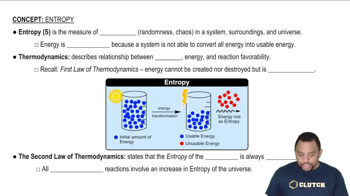
(a) What is the difference between a state and a microstate of a system?
426
views

 검증된 단계별 안내
 02:46
02:46
 03:42
03:42 00:48
00:48(a) What is the difference between a state and a microstate of a system?
Indicate whether each statement is true or false. (c) In a certain spontaneous process the system undergoes an entropy change of 4.2 J/K; therefore, the entropy change of the surroundings must be -4.2 J/K.
For the isothermal expansion of a gas into a vacuum, ΔE = 0, q = 0, and w = 0. (b) Explain why no work is done by the system during this process.
(a) What sign for Δ𝑆 do you expect when the pressure on 0.600 mol of an ideal gas at 350 K is increased isothermally from an initial pressure of 0.750 atm?
(b) If the final pressure on the gas is 1.20 atm, calculate the entropy change for the process.
(c) Which of the following statements about this process are true? (i) The entropy change you calculated will be the same for at any other constant temperature. (ii) The value of Δ𝑆 you calculated is valid only if the compression is done irreversibly. (iii) If the number of moles of gas being compressed were decreased by a factor of three, the entropy change would increase by a factor of three.
(a) Does the entropy of the surroundings increase for spontaneous processes?
(b) In a particular spontaneous process the entropy of the system decreases. What can you conclude about the sign and magnitude of ΔSsurr?