
Ch.2 - Atoms, Molecules, and Ions
Brown - Chemistry: The Central Science 15th Edition
Brown15th EditionChemistry: The Central ScienceISBN: 9780137542970당신이 사용하는 게 아니라요?교과서 변경
2장, 문제 15

Which of the subatomic particles in an atom does not have a charge (and was therefore the last to be discovered)?

검증된 단계별 안내
1
Identify the three main subatomic particles in an atom: protons, neutrons, and electrons.
Recall that protons have a positive charge, electrons have a negative charge, and neutrons have no charge.
Understand that the discovery of subatomic particles was influenced by their charge and mass.
Recognize that because neutrons have no charge, they do not interact with electric or magnetic fields, making them harder to detect.
Conclude that neutrons were the last of the three main subatomic particles to be discovered due to their lack of charge.

비슷한 문제에 대한 검증된 영상 답변:

이 영상 해법은 위 문제에 도움이 된다고 튜터들이 추천한 것입니다.
영상 길이:
9m
도움이 되었나요?

주요 개념

질문에 올바르게 답하기 위해 반드시 이해해야 하는 핵심 개념들은 다음과 같습니다.

Subatomic Particles

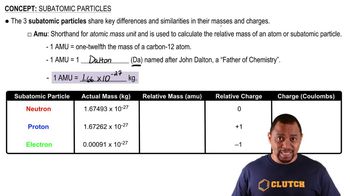
Subatomic particles are the fundamental constituents of atoms, primarily including protons, neutrons, and electrons. Protons carry a positive charge, electrons carry a negative charge, and neutrons are neutral, meaning they have no charge. Understanding these particles is essential for grasping atomic structure and behavior.
추천 영상:
가이드 코스
05:19
Subatomic Particles

Neutrons

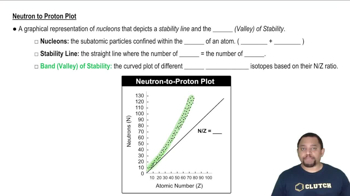
Neutrons are neutral subatomic particles found in the nucleus of an atom alongside protons. They play a crucial role in stabilizing the nucleus by offsetting the repulsive forces between positively charged protons. Neutrons were the last of the three main subatomic particles to be discovered, highlighting their significance in atomic theory.
추천 영상:
가이드 코스
01:38
Neutron-to-Proton Plot

Atomic Structure

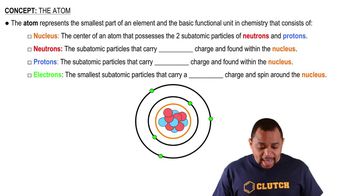
Atomic structure refers to the arrangement of subatomic particles within an atom, which includes the nucleus (composed of protons and neutrons) and the electron cloud surrounding it. This structure determines the chemical properties of elements and their interactions. A clear understanding of atomic structure is vital for studying chemical reactions and bonding.
추천 영상:
관련 실천
교과서 질문

In a series of experiments, a chemist prepared three different compounds that contain only iodine and fluorine and determined the mass of each element in each compound: Compound Mass of Iodine (g) Mass of Fluorine (g) 1 4.75 3.56 2 7.64 3.43 3 9.41 9.86 (b) How do the numbers in part (a) support the atomic theory?

649
views
1
rank
교과서 질문

In a series of experiments, a chemist prepared three different compounds that contain only iodine and fluorine and determined the mass of each element in each compound: Compound Mass of Iodine (g) Mass of Fluorine (g) 1 4.75 3.56 2 7.64 3.43 3 9.41 9.86 (a) Calculate the mass of fluorine per gram of iodine in Compound 3.

742
views
교과서 질문

An unknown particle is caused to move between two electrically charged plates, as illustrated in Figure 2.7. You hypothesize that the particle is a proton. (b) Would it be deflected by a smaller or larger amount than the b rays?

515
views
교과서 질문

An unknown particle is caused to move between two electrically charged plates, as illustrated in Figure 2.7. You hypothesize that the particle is a proton. (a) If your hypothesis is correct, would the particle be deflected in the same or opposite direction as the b rays?

823
views
교과서 질문

In a series of experiments, a chemist prepared three different compounds that contain only iodine and fluorine and determined the mass of each element in each compound: Compound Mass of Iodine (g) Mass of Fluorine (g) 1 4.75 3.56 2 7.64 3.43 3 9.41 9.86 (a) Calculate the mass of fluorine per gram of iodine in Compound 1 and 2.

882
views
교과서 질문

Which set of statements is true about Rutherford’s gold foil experiment?

i. This is the main experiment that showed that atoms have a dense nucleus.

ii. The data from the experiment showed that alpha particles scattered equally at all angles from the gold foil.

iii. Electrons were emitted from the gold atoms in straight lines.


a. i only

b. ii only

c. iii only

d. i and ii

e. i and iii