
Ch.2 - Atoms, Molecules, and Ions
Brown - Chemistry: The Central Science 15th Edition
Brown15th EditionChemistry: The Central ScienceISBN: 9780137542970당신이 사용하는 게 아니라요?교과서 변경
2장, 문제 17

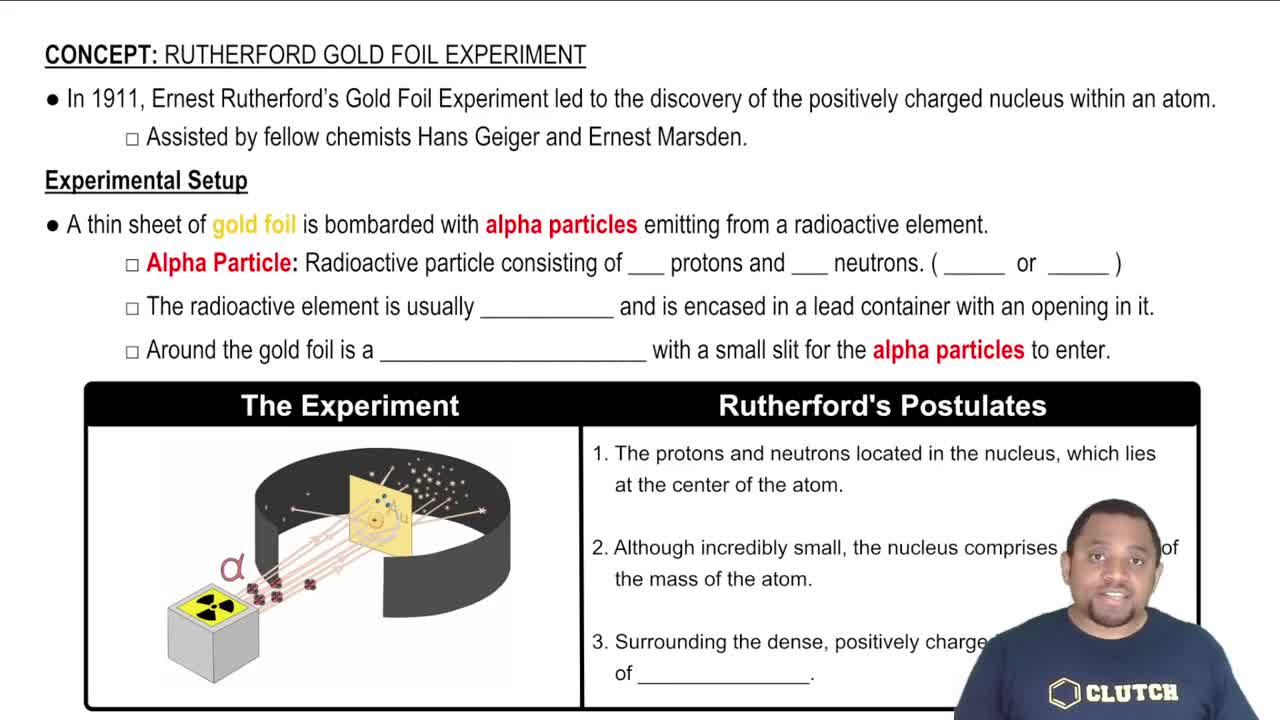
Which set of statements is true about Rutherford’s gold foil experiment?
i. This is the main experiment that showed that atoms have a dense nucleus.
ii. The data from the experiment showed that alpha particles scattered equally at all angles from the gold foil.
iii. Electrons were emitted from the gold atoms in straight lines.


a. i only
b. ii only
c. iii only
d. i and ii
e. i and iii

검증된 단계별 안내
1
Review the historical context of Rutherford's gold foil experiment, which was conducted to explore the structure of the atom.
Understand that the experiment involved directing alpha particles at a thin sheet of gold foil and observing their scattering patterns.
Recall that the key finding was that most alpha particles passed through the foil with little deflection, but a small fraction were deflected at large angles, indicating a dense, positively charged nucleus.
Evaluate statement i: It is true because the experiment demonstrated the existence of a dense nucleus at the center of the atom.
Evaluate statement ii: It is false because the alpha particles did not scatter equally at all angles; most passed through with little deflection, and only a few were deflected at large angles.

비슷한 문제에 대한 검증된 영상 답변:

이 영상 해법은 위 문제에 도움이 된다고 튜터들이 추천한 것입니다.
영상 길이:
4m

주요 개념

질문에 올바르게 답하기 위해 반드시 이해해야 하는 핵심 개념들은 다음과 같습니다.

Rutherford's Gold Foil Experiment

Rutherford's gold foil experiment, conducted in 1909, was pivotal in demonstrating that atoms consist of a small, dense nucleus surrounded by electrons. In this experiment, alpha particles were directed at a thin sheet of gold foil, and their scattering patterns provided insights into atomic structure, leading to the conclusion that most of an atom's mass is concentrated in the nucleus.
추천 영상:
가이드 코스
04:22
Rutherford Gold Foil Experiment

Alpha Particle Scattering

The scattering of alpha particles in Rutherford's experiment revealed that while most particles passed through the foil, a small fraction were deflected at large angles. This unexpected result indicated that the positive charge and mass of an atom are concentrated in a tiny nucleus, contradicting the then-accepted plum pudding model of atomic structure.
추천 영상:
가이드 코스
02:48
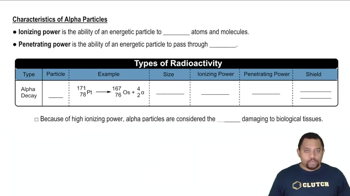
Characteristics of Alpha Particles

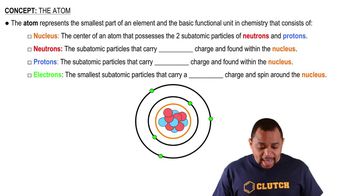
Atomic Structure

The atomic structure concept refers to the arrangement of protons, neutrons, and electrons within an atom. Rutherford's findings led to the nuclear model of the atom, where electrons orbit a dense nucleus made of protons and neutrons, fundamentally changing the understanding of atomic composition and paving the way for modern atomic theory.
추천 영상:
관련 실천
교과서 질문

Millikan determined the charge on the electron by studying the static charges on oil drops falling in an electric field (Figure 2.5). A student carried out this experiment using several oil drops for her measurements and calculated the charges on the drops. She obtained the following data: Droplet Calculated Charge (C) A 1.60 * 10-19 B 3.15 * 10-19 C 4.81 * 10-19 D 6.31 * 10-19 (b) What conclusion can the student draw from these data regarding the charge of the electron?

1377
views
교과서 질문

Which of the subatomic particles in an atom does not have a charge (and was therefore the last to be discovered)?

2
views
교과서 질문

An unknown particle is caused to move between two electrically charged plates, as illustrated in Figure 2.7. You hypothesize that the particle is a proton. (b) Would it be deflected by a smaller or larger amount than the b rays?

515
views
교과서 질문

An unknown particle is caused to move between two electrically charged plates, as illustrated in Figure 2.7. You hypothesize that the particle is a proton. (a) If your hypothesis is correct, would the particle be deflected in the same or opposite direction as the b rays?

823
views
교과서 질문

The radius of an atom of gold (Au) is about 1.35 Å. a. Express this distance in nanometers (nm) and in picometers (pm).

2
views
교과서 질문

Millikan determined the charge on the electron by studying the static charges on oil drops falling in an electric field (Figure 2.5). A student carried out this experiment using several oil drops for her measurements and calculated the charges on the drops. She obtained the following data: Droplet Calculated Charge (C) A 1.60 * 10-19 B 3.15 * 10-19 C 4.81 * 10-19 D 6.31 * 10-19 (c) What value (and to how many significant figures) should she report for the electronic charge?

579
views