Ch.23 - Transition Metals and Coordination Chemistry

Brown15th EditionChemistry: The Central ScienceISBN: 9780137542970
당신이 사용하는 게 아니라요?교과서 변경다른 교과서를 선택하세요
TOC.tableOfContents
- Ch.1 - Introduction: Matter, Energy, and Measurement146
- Ch.2 - Atoms, Molecules, and Ions200
- Ch.3 - Chemical Reactions and Reaction Stoichiometry176
- Ch.4 - Reactions in Aqueous Solution155
- Ch.5 - Thermochemistry126
- Ch.6 - Electronic Structure of Atoms131
- Ch.7 - Periodic Properties of the Elements126
- Ch.8 - Basic Concepts of Chemical Bonding123
- Ch.9 - Molecular Geometry and Bonding Theories143
- Ch.10 - Gases147
- Ch.11 - Liquids and Intermolecular Forces91
- Ch.12 - Solids and Modern Materials122
- Ch.13 - Properties of Solutions126
- Ch.14 - Chemical Kinetics174
- Ch.15 - Chemical Equilibrium101
- Ch.16 - Acid-Base Equilibria139
- Ch.17 - Additional Aspects of Aqueous Equilibria146
- Ch.18 - Chemistry of the Environment72
- Ch.19 - Chemical Thermodynamics129
- Ch.20 - Electrochemistry142
- Ch.21 - Nuclear Chemistry101
- Ch.22 - Chemistry of the Nonmetals68
- Ch.23 - Transition Metals and Coordination Chemistry66
- Ch.24 - The Chemistry of Life: Organic and Biological Chemistry10

23장, 문제 46
Complete the exercises below. Determine if each of the following metal complexes is chiral and therefore has an optical isomer: a. square planar [Pd(en)(CN)₂].
 검증된 단계별 안내
1
Step 1: Understand the concept of chirality in coordination complexes. Chirality occurs when a molecule cannot be superimposed on its mirror image, often due to the presence of a chiral center.
Step 2: Identify the geometry of the complex. The given complex [Pd(en)(CN)₂] is described as square planar, which is a common geometry for d⁸ metal ions like Pd(II).
Step 3: Analyze the ligands in the complex. The complex contains ethylenediamine (en), a bidentate ligand, and two cyanide (CN⁻) ligands. Ethylenediamine can potentially introduce chirality due to its ability to form chelate rings.
Step 4: Consider the symmetry of the complex. In a square planar complex, the arrangement of ligands around the central metal ion is typically symmetric. Check if the arrangement of ligands allows for a non-superimposable mirror image.
Step 5: Determine if the complex is chiral. For a square planar complex to be chiral, it must lack a plane of symmetry. Evaluate the spatial arrangement of the ligands to see if such a plane exists.
주요 개념
질문에 올바르게 답하기 위해 반드시 이해해야 하는 핵심 개념들은 다음과 같습니다.
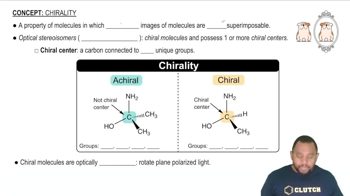
Chirality
Chirality refers to the geometric property of a molecule that makes it non-superimposable on its mirror image, much like left and right hands. A chiral molecule typically has at least one chiral center, often a carbon atom bonded to four different substituents. In coordination chemistry, chirality can arise from the arrangement of ligands around a central metal atom, leading to distinct optical isomers.
추천 영상:
가이드 코스
 02:37
02:37
Chirality
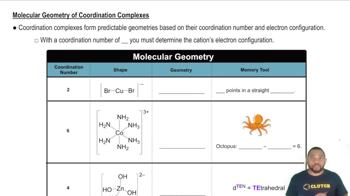
Coordination Geometry
Coordination geometry describes the spatial arrangement of ligands around a central metal ion in a complex. Common geometries include octahedral, tetrahedral, and square planar. The geometry influences the symmetry of the complex, which is crucial for determining whether the complex can exist as chiral isomers.
추천 영상:
가이드 코스
 02:40
02:40Molecular Geometry of Coordination Complexes
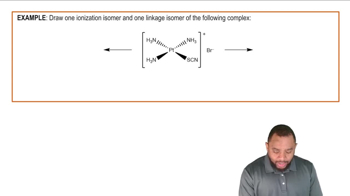
Optical Isomerism
Optical isomerism is a form of stereoisomerism where isomers differ in the way they rotate plane-polarized light. Chiral compounds can exist as two enantiomers, which are mirror images of each other and have different optical activities. The presence of optical isomers is significant in many fields, including pharmaceuticals, where different enantiomers can have different biological effects.
추천 영상:
가이드 코스
 2:14
2:14Isomerism in Coordination Complexes Example
관련 실천