Ch.4 - Reactions in Aqueous Solution
Brown - Chemistry: The Central Science 15th Edition
Brown15th EditionChemistry: The Central ScienceISBN: 9780137542970당신이 사용하는 게 아니라요?교과서 변경
4장, 문제 24b

Identify the precipitate (if any) that forms when the following solutions are mixed, and write a balanced equation for each reaction. b. KOH and Cu(NO3)2


검증된 단계별 안내
1
Identify the ions present in each solution: KOH dissociates into K^+ and OH^- ions, while Cu(NO_3)_2 dissociates into Cu^{2+} and NO_3^- ions.
Determine the possible combinations of cations and anions that can form new compounds: K^+ with NO_3^- and Cu^{2+} with OH^-.
Use solubility rules to determine which of these combinations, if any, will form a precipitate: KNO_3 is soluble, while Cu(OH)_2 is insoluble.
Write the balanced chemical equation for the reaction, showing the formation of the precipitate: Cu(OH)_2(s) is the precipitate formed.
Balance the equation by ensuring the number of atoms of each element is the same on both sides of the equation.

비슷한 문제에 대한 검증된 영상 답변:

이 영상 해법은 위 문제에 도움이 된다고 튜터들이 추천한 것입니다.
영상 길이:
5m
도움이 되었나요?

주요 개념

질문에 올바르게 답하기 위해 반드시 이해해야 하는 핵심 개념들은 다음과 같습니다.

Precipitation Reactions

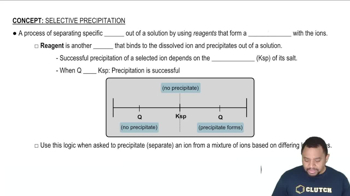
Precipitation reactions occur when two soluble salts react in solution to form an insoluble product, known as a precipitate. This process is driven by the formation of a compound that cannot remain dissolved in the solvent, leading to the separation of solid material from the liquid. Understanding solubility rules helps predict whether a precipitate will form when two solutions are mixed.
추천 영상:
가이드 코스
01:53
Selective Precipitation

Solubility Rules

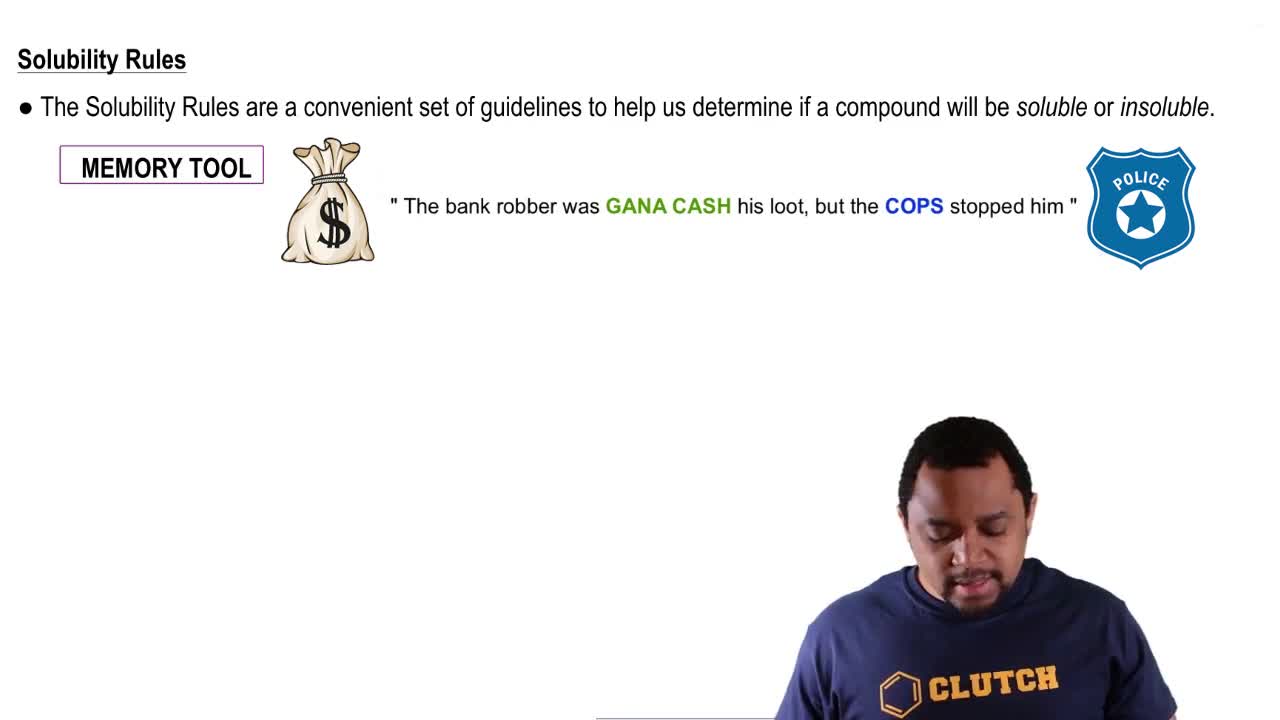
Solubility rules are guidelines that help predict the solubility of various ionic compounds in water. For example, most hydroxides are insoluble except for those of alkali metals and some alkaline earth metals. In the case of KOH and Cu(NO3)2, knowing these rules allows us to determine that Cu(OH)2 will precipitate when these two solutions are mixed.
추천 영상:
가이드 코스
00:28
Solubility Rules

Balanced Chemical Equations

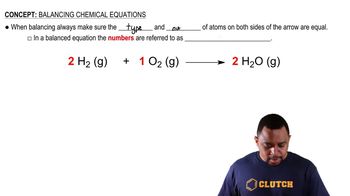
A balanced chemical equation represents a chemical reaction with equal numbers of each type of atom on both sides of the equation. Balancing ensures the law of conservation of mass is upheld, meaning that matter is neither created nor destroyed in the reaction. For the reaction between KOH and Cu(NO3)2, the balanced equation will show the formation of Cu(OH)2 as a precipitate along with the remaining soluble products.
추천 영상:
가이드 코스
01:32
Balancing Chemical Equations