Identify the precipitate (if any) that forms when the following solutions are mixed, and write a balanced equation for each reaction. b. KOH and Cu(NO3)2
Ch.4 - Reactions in Aqueous Solution

4장, 문제 25a
Which ions remain in solution, unreacted, after each of the following pairs of solutions is mixed? (a) potassium carbonate and magnesium sulfate
검증된 단계별 안내1
Identify the ions present in each solution: Potassium carbonate (K2CO3) dissociates into 2 K^+ ions and 1 CO3^2- ion. Magnesium sulfate (MgSO4) dissociates into 1 Mg^2+ ion and 1 SO4^2- ion.
Determine the possible products of the reaction: When these solutions are mixed, the possible products are magnesium carbonate (MgCO3) and potassium sulfate (K2SO4).
Consider the solubility rules: Magnesium carbonate (MgCO3) is generally insoluble in water, while potassium sulfate (K2SO4) is soluble.
Predict the precipitate: Since MgCO3 is insoluble, it will precipitate out of the solution, leaving the other ions in solution.
Identify the ions remaining in solution: The ions that remain in solution are the ones that do not form the precipitate, which are K^+ and SO4^2- ions.

비슷한 문제에 대한 검증된 영상 답변:
이 영상 해법은 위 문제에 도움이 된다고 튜터들이 추천한 것입니다.
영상 길이:
4m주요 개념
질문에 올바르게 답하기 위해 반드시 이해해야 하는 핵심 개념들은 다음과 같습니다.
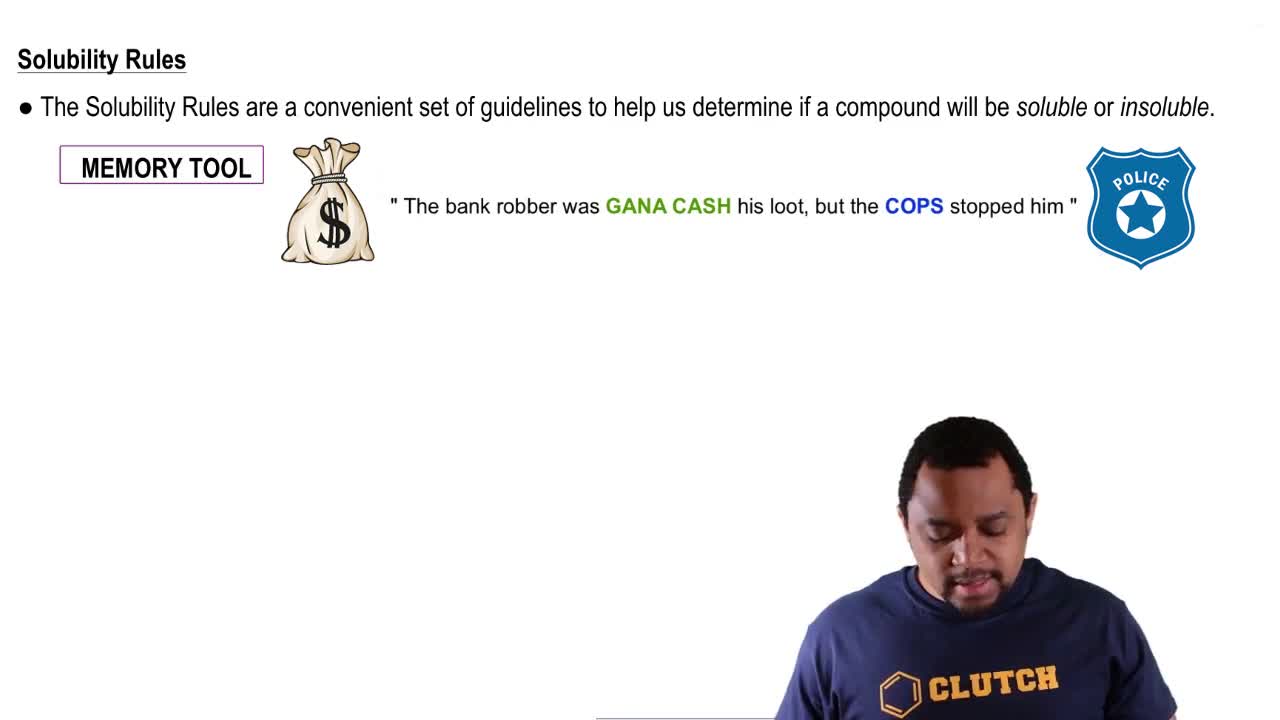
Solubility Rules
Solubility rules are guidelines that help predict whether a compound will dissolve in water. For example, most alkali metal salts, like potassium carbonate, are soluble, while some sulfates, such as those of barium and lead, are insoluble. Understanding these rules is crucial for determining which ions remain in solution after mixing different compounds.
추천 영상:
가이드 코스
Solubility Rules
Precipitation Reactions
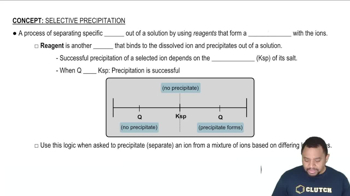
A precipitation reaction occurs when two soluble salts are mixed, resulting in the formation of an insoluble compound that precipitates out of solution. In the case of potassium carbonate and magnesium sulfate, the potential formation of magnesium carbonate, which is insoluble, must be considered to identify which ions remain in solution.
추천 영상:
가이드 코스
Selective Precipitation
Ionic Equations
Ionic equations represent the species present in a solution and help visualize the interactions between ions. By writing the complete ionic equation for the reaction between potassium carbonate and magnesium sulfate, one can identify the spectator ions—those that do not participate in the reaction and remain unreacted in the solution.
추천 영상:
가이드 코스
Net Ionic Equations
관련 실천
교과서 질문
3
views
교과서 질문
Which ions remain in solution, unreacted, after each of the following pairs of solutions is mixed? (c) ammonium phosphate and calcium chloride
904
views
교과서 질문
Predict whether each of the following compounds is soluble in water: d. Al(OH)3
3
views
교과서 질문
Write balanced net ionic equations for the reactions that occur in each of the following cases. Identify the spectator ion or ions in each reaction. a. Cr2(SO4)3(𝑎𝑞)+(NH4)2CO3(𝑎𝑞)⟶
6
views
교과서 질문
Write balanced net ionic equations for the reactions that occur in each of the following cases. Identify the spectator ion or ions in each reaction. c. Fe(NO3)2(𝑎𝑞)+KOH(𝑎𝑞)⟶
2
views
교과서 질문
Will precipitation occur when the following solutions are mixed? If so, write a balanced chemical equation for the reaction. c. FeSO4 and Pb(NO3)2
3
views