
Ozone, O3(g), is a form of elemental oxygen that plays an important role in the absorption of ultraviolet radiation in the stratosphere. It decomposes to O2(g) at room temperature and pressure according to the following reaction: 2 O3(g) → 3 O2(g) ΔH= -284.6 kJ b. Which has the higher enthalpy under these conditions, 2 O3(g) or 3 O2(g)?
Ch.5 - Thermochemistry

5장, 문제 42c
Without referring to tables, predict which of the following has the higher enthalpy in each case: (c) 1 mol H2(g) and 0.5 mol O2(g) at 25 °C or 1 mol H2O(g) at 25 °C
검증된 단계별 안내1
Identify the chemical reaction involved: H_2(g) + 0.5 O_2(g) \(\rightarrow\) H_2O(g).
Understand that the enthalpy change (\(\Delta\) H) for this reaction is related to the formation of water from hydrogen and oxygen.
Recall that the enthalpy of formation for a compound is typically negative, indicating that energy is released when the compound forms from its elements.
Consider that the reactants (H_2 and O_2) are in their elemental forms, which generally have higher enthalpy compared to the compound formed (H_2O).
Conclude that the enthalpy of the reactants (H_2 and O_2) is higher than that of the product (H_2O) because energy is released during the formation of water.

비슷한 문제에 대한 검증된 영상 답변:
이 영상 해법은 위 문제에 도움이 된다고 튜터들이 추천한 것입니다.
영상 길이:
1m주요 개념
질문에 올바르게 답하기 위해 반드시 이해해야 하는 핵심 개념들은 다음과 같습니다.
Enthalpy
Enthalpy is a thermodynamic property that represents the total heat content of a system. It is defined as the sum of the internal energy and the product of pressure and volume. Enthalpy changes are crucial for understanding heat transfer during chemical reactions, particularly in constant pressure conditions, which is common in many chemical processes.
추천 영상:
가이드 코스
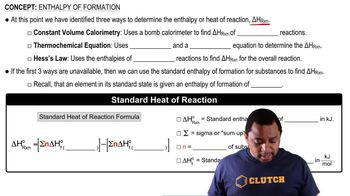
Enthalpy of Formation
Standard State Conditions
Standard state conditions refer to a set of specific conditions (usually 1 atm pressure and a specified temperature, often 25 °C) under which the properties of substances are measured. These conditions allow for consistent comparisons of enthalpy values, as substances can exist in different phases (solid, liquid, gas) under varying conditions, affecting their enthalpy.
추천 영상:
가이드 코스
Standard Reduction Potentials
Phase Changes and Enthalpy of Formation
The enthalpy of formation is the change in enthalpy when one mole of a compound is formed from its elements in their standard states. Understanding the enthalpy of formation for water and the gaseous reactants is essential for predicting which has a higher enthalpy, as phase changes (from gas to liquid or solid) significantly influence the enthalpy values due to the energy associated with breaking or forming bonds.
추천 영상:
가이드 코스
Enthalpy of Formation
관련 실천
교과서 질문
5
views
교과서 질문
Consider the following reaction: 2 CH3OH(g) → 2 CH4(g) + O2(g) ΔH = +252.8 kJ (d) How many kilojoules of heat are released when 38.5 g of CH4(g) reacts completely with O2(g) to form CH3OH(g) at constant pressure?
458
views
교과서 질문
Without referring to tables, predict which of the following has the higher enthalpy in each case: (b) 2 mol of hydrogen atoms or 1 mol of H2
2
views
교과서 질문
Consider the following reaction: 2 CH3OH(g) → 2 CH4(g) + O2(g) ΔH = +252.8 kJ (b) Calculate the amount of heat transferred when 24.0 g of CH3OH(g) is decomposed by this reaction at constant pressure.
719
views
1
rank
교과서 질문
Without referring to tables, predict which of the following has the higher enthalpy in each case: (a) 1 mol CO2(s) or 1 mol CO2(g) at the same temperature
3
views
