
When solutions containing silver ions and chloride ions are mixed, silver chloride precipitates Ag+(aq) + Cl-(aq) → AgCl(s) H = -65.5 kJ (a) Calculate H for the production of 0.450 mol of AgCl by this reaction. (b) Calculate H for the production of 9.00 g of AgCl. (c) Calculate H when 9.25⨉10-4 mol of AgCl dissolves in water.
Ch.5 - Thermochemistry

5장, 문제 44b
Consider the following reaction: 2 CH3OH(g) → 2 CH4(g) + O2(g) ΔH = +252.8 kJ (b) Calculate the amount of heat transferred when 24.0 g of CH3OH(g) is decomposed by this reaction at constant pressure.
검증된 단계별 안내1
Determine the molar mass of CH_3OH by adding the atomic masses of its constituent atoms: C (12.01 g/mol), H (1.01 g/mol), and O (16.00 g/mol).
Calculate the number of moles of CH_3OH in 24.0 g by dividing the mass by the molar mass.
Use the stoichiometry of the reaction to relate the moles of CH_3OH to the enthalpy change (ΔH). The reaction shows that 2 moles of CH_3OH correspond to an enthalpy change of +252.8 kJ.
Calculate the heat transferred for the moles of CH_3OH you have by setting up a proportion based on the stoichiometry: (moles of CH_3OH / 2 moles) = (x kJ / 252.8 kJ).
Solve for x to find the amount of heat transferred when 24.0 g of CH_3OH is decomposed.

비슷한 문제에 대한 검증된 영상 답변:
이 영상 해법은 위 문제에 도움이 된다고 튜터들이 추천한 것입니다.
영상 길이:
1m주요 개념
질문에 올바르게 답하기 위해 반드시 이해해야 하는 핵심 개념들은 다음과 같습니다.
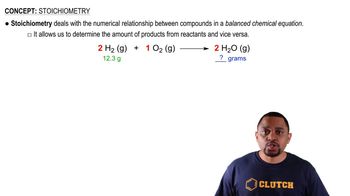
Stoichiometry
Stoichiometry is the calculation of reactants and products in chemical reactions based on the balanced equation. It allows us to determine the relationships between the quantities of substances involved in a reaction. In this case, knowing the molar ratios from the balanced equation helps us convert grams of CH₃OH to moles, which is essential for calculating heat transfer.
추천 영상:
가이드 코스
Stoichiometry Concept
Enthalpy Change (ΔH)
Enthalpy change (ΔH) represents the heat absorbed or released during a chemical reaction at constant pressure. A positive ΔH indicates that the reaction is endothermic, meaning it absorbs heat from the surroundings. In this reaction, ΔH = +252.8 kJ signifies that 252.8 kJ of heat is required to decompose 2 moles of CH₃OH, which is crucial for calculating the heat transferred for a specific mass.
추천 영상:
가이드 코스
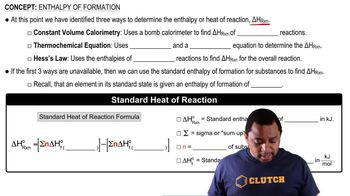
Enthalpy of Formation
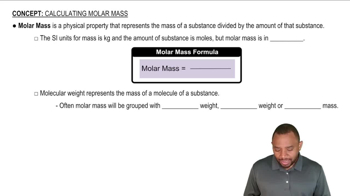
Molar Mass
Molar mass is the mass of one mole of a substance, typically expressed in grams per mole (g/mol). It is essential for converting between the mass of a substance and the number of moles. For CH₃OH, the molar mass is approximately 32.04 g/mol, which allows us to calculate how many moles are present in 24.0 g, facilitating the determination of the heat transferred in the reaction.
추천 영상:
가이드 코스
Molar Mass Concept
관련 실천
교과서 질문
861
views
교과서 질문
At one time, a common means of forming small quantities of oxygen gas in the laboratory was to heat KClO3: 2 KClO3(s) → 2 KCl(s) + 3 O2(g) ΔH = -89.4 kJ For this reaction, calculate H for the formation of (a) 1.36 mol of O2
560
views
교과서 질문
Without referring to tables, predict which of the following has the higher enthalpy in each case: (c) 1 mol H2(g) and 0.5 mol O2(g) at 25 °C or 1 mol H2O(g) at 25 °C
2
views
교과서 질문
Consider the following reaction: 2 CH3OH(g) → 2 CH4(g) + O2(g) ΔH = +252.8 kJ (d) How many kilojoules of heat are released when 38.5 g of CH4(g) reacts completely with O2(g) to form CH3OH(g) at constant pressure?
458
views
교과서 질문
Without referring to tables, predict which of the following has the higher enthalpy in each case: (b) 2 mol of hydrogen atoms or 1 mol of H2
2
views
