Ch.5 - Thermochemistry
Brown - Chemistry: The Central Science 15th Edition
Brown15th EditionChemistry: The Central ScienceISBN: 9780137542970당신이 사용하는 게 아니라요?교과서 변경
5장, 문제 47a

Consider the combustion of isopropanol, C3H7OH(l), which is the primary component of rubbing alcohol: C3H7OH(l) + 9/2 O2(g) → 3 CO2(g) + 4 H2O(l) ΔH = -2248 kJ a. What is the enthalpy change for the reverse reaction?

검증된 단계별 안내
1
Identify the given reaction: C_3H_7OH(l) + \(\frac{9}{2}\) O_2(g) \(\rightarrow\) 3 CO_2(g) + 4 H_2O(l) with \(\Delta\) H = -2248 \(\text{ kJ}\).
Understand that the enthalpy change (\(\Delta\) H) for a reaction is the energy change when the reaction occurs as written.
For the reverse reaction, the products and reactants are swapped: 3 CO_2(g) + 4 H_2O(l) \(\rightarrow\) C_3H_7OH(l) + \(\frac{9}{2}\) O_2(g).
The enthalpy change for the reverse reaction is the negative of the enthalpy change for the forward reaction.
Calculate the enthalpy change for the reverse reaction by changing the sign of the given \(\Delta\) H: \(\Delta\) H_{reverse} = -(-2248 \(\text{ kJ}\)).

비슷한 문제에 대한 검증된 영상 답변:

이 영상 해법은 위 문제에 도움이 된다고 튜터들이 추천한 것입니다.
영상 길이:
1m

주요 개념

질문에 올바르게 답하기 위해 반드시 이해해야 하는 핵심 개념들은 다음과 같습니다.

Enthalpy Change

Enthalpy change (ΔH) is a measure of the heat absorbed or released during a chemical reaction at constant pressure. In exothermic reactions, like the combustion of isopropanol, ΔH is negative, indicating that heat is released. Understanding enthalpy is crucial for predicting the energy changes associated with chemical reactions, including both forward and reverse processes.
추천 영상:
가이드 코스
02:34
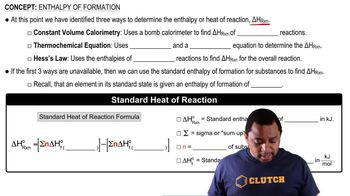
Enthalpy of Formation

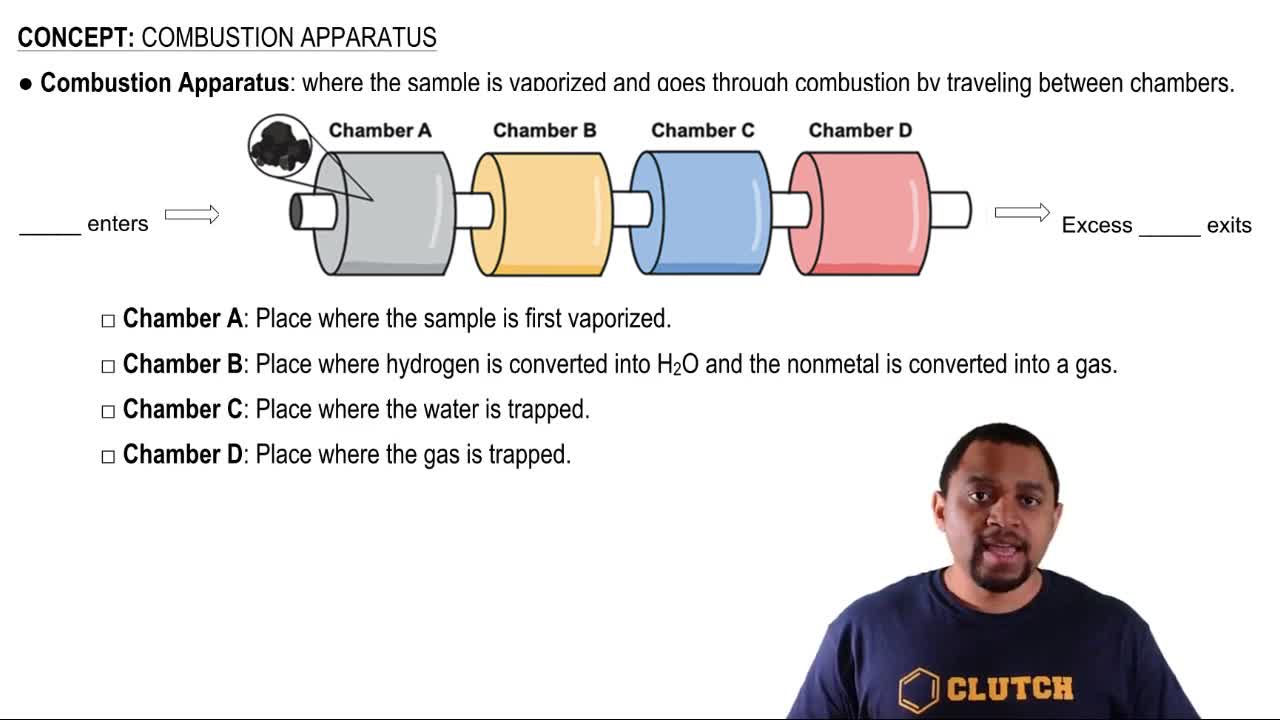
Combustion Reactions

Combustion reactions involve the reaction of a substance with oxygen, producing heat and light. In the case of isopropanol, the combustion results in carbon dioxide and water as products. Recognizing the characteristics of combustion reactions helps in understanding the energy dynamics and the stoichiometry involved in the reaction, which is essential for calculating enthalpy changes.
추천 영상:
가이드 코스
02:24
Combustion Apparatus

Reverse Reaction

The reverse reaction of a chemical process is simply the reaction proceeding in the opposite direction. For the combustion of isopropanol, the reverse reaction would involve the formation of isopropanol from carbon dioxide and water. The enthalpy change for the reverse reaction is equal in magnitude but opposite in sign to that of the forward reaction, which is a fundamental principle in thermodynamics.
추천 영상:
가이드 코스
03:42
Reversible Changes in Matter
관련 실천
교과서 질문

At one time, a common means of forming small quantities of oxygen gas in the laboratory was to heat KClO3: 2 KClO3(s) → 2 KCl(s) + 3 O2(g) ΔH = -89.4 kJ For this reaction, calculate H for the formation of (a) 1.36 mol of O2

560
views

교과서 질문

At one time, a common means of forming small quantities of oxygen gas in the laboratory was to heat KClO3: 2 KClO3(s) → 2 KCl(s) + 3 O2(g) ΔH = -89.4 kJ For this reaction, calculate H for the formation of (b) 10.4 g of KCl.

423
views
교과서 질문

Consider the decomposition of liquid benzene, C6H6(l), to gaseous acetylene, C2H2(g): C6H6(l) → 3 C2H2(g) ΔH = +630 kJ (a) What is the enthalpy change for the reverse reaction?

803
views
교과서 질문

Consider the decomposition of liquid benzene, C6H6(l), to gaseous acetylene, C2H2(g): C6H6(l) → 3 C2H2(g) ΔH = +630 kJ (b) What is H for the formation of 1 mol of acetylene?

373
views
교과서 질문

Consider the combustion of isopropanol, C3H7OH(l), which is the primary component of rubbing alcohol: C3H7OH(l) + 9/2 O2(g) → 3 CO2(g) + 4 H2O(l) ΔH = -2248 kJ (b) Balance the forward reaction with whole-number coefficients. What is ΔH for the reaction represented by this equation?

3
views
교과서 질문

At one time, a common means of forming small quantities of oxygen gas in the laboratory was to heat KClO3: 2 KClO3(s) → 2 KCl(s) + 3 O2(g) ΔH = -89.4 kJ c. Now consider the reverse reaction, in which KClO3 is formed from KCl and O2. What is Δ𝐻 for the formation of 19.1 g KClO3 from KCl and O2?

5
views