
Ch.5 - Thermochemistry
Brown - Chemistry: The Central Science 15th Edition
Brown15th EditionChemistry: The Central ScienceISBN: 9780137542970당신이 사용하는 게 아니라요?교과서 변경
5장, 문제 46a

At one time, a common means of forming small quantities of oxygen gas in the laboratory was to heat KClO3: 2 KClO3(s) → 2 KCl(s) + 3 O2(g) ΔH = -89.4 kJ For this reaction, calculate H for the formation of (a) 1.36 mol of O2

검증된 단계별 안내
1
Identify the given reaction: 2 KClO_3(s) → 2 KCl(s) + 3 O_2(g) with ΔH = -89.4 kJ.
Understand that ΔH = -89.4 kJ is for the formation of 3 moles of O_2.
Set up a proportion to find ΔH for 1.36 moles of O_2: (ΔH for 1.36 mol O_2) / (ΔH for 3 mol O_2) = 1.36 mol / 3 mol.
Solve the proportion to find ΔH for 1.36 moles of O_2.
Ensure the units are consistent and the sign of ΔH reflects the exothermic nature of the reaction.

비슷한 문제에 대한 검증된 영상 답변:

이 영상 해법은 위 문제에 도움이 된다고 튜터들이 추천한 것입니다.
영상 길이:
3m

주요 개념

질문에 올바르게 답하기 위해 반드시 이해해야 하는 핵심 개념들은 다음과 같습니다.

Stoichiometry

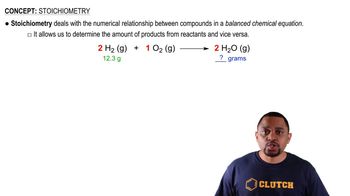
Stoichiometry is the branch of chemistry that deals with the quantitative relationships between the reactants and products in a chemical reaction. It allows us to calculate the amounts of substances consumed and produced in a reaction based on balanced chemical equations. In this case, the stoichiometric coefficients from the reaction indicate that 3 moles of O2 are produced for every 2 moles of KClO3 decomposed.
추천 영상:
가이드 코스
01:16
Stoichiometry Concept

Enthalpy Change (ΔH)

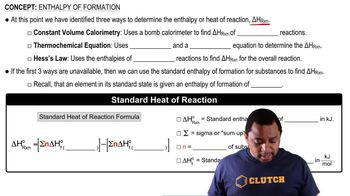
Enthalpy change (ΔH) is a measure of the heat content of a system at constant pressure. It indicates whether a reaction is exothermic (releases heat, ΔH < 0) or endothermic (absorbs heat, ΔH > 0). In the given reaction, ΔH = -89.4 kJ signifies that the decomposition of KClO3 releases 89.4 kJ of energy for every 2 moles of KClO3 reacted, which is crucial for calculating the energy change for the formation of 1.36 moles of O2.
추천 영상:
가이드 코스
02:34
Enthalpy of Formation

Molar Relationships

Molar relationships refer to the ratios of moles of reactants and products in a balanced chemical equation. These relationships are essential for converting between moles of different substances. In this scenario, knowing that 3 moles of O2 are produced from 2 moles of KClO3 allows us to determine the amount of energy associated with the formation of 1.36 moles of O2 by using the established stoichiometric ratios.
추천 영상:
관련 실천
교과서 질문

When solutions containing silver ions and chloride ions are mixed, silver chloride precipitates Ag+(aq) + Cl-(aq) → AgCl(s) H = -65.5 kJ (a) Calculate H for the production of 0.450 mol of AgCl by this reaction. (b) Calculate H for the production of 9.00 g of AgCl. (c) Calculate H when 9.25⨉10-4 mol of AgCl dissolves in water.

861
views
교과서 질문

At one time, a common means of forming small quantities of oxygen gas in the laboratory was to heat KClO3: 2 KClO3(s) → 2 KCl(s) + 3 O2(g) ΔH = -89.4 kJ For this reaction, calculate H for the formation of (b) 10.4 g of KCl.

423
views
교과서 질문

Consider the following reaction: 2 CH3OH(g) → 2 CH4(g) + O2(g) ΔH = +252.8 kJ (d) How many kilojoules of heat are released when 38.5 g of CH4(g) reacts completely with O2(g) to form CH3OH(g) at constant pressure?

458
views
교과서 질문

Consider the following reaction: 2 CH3OH(g) → 2 CH4(g) + O2(g) ΔH = +252.8 kJ (b) Calculate the amount of heat transferred when 24.0 g of CH3OH(g) is decomposed by this reaction at constant pressure.

719
views
1
rank
교과서 질문

At one time, a common means of forming small quantities of oxygen gas in the laboratory was to heat KClO3: 2 KClO3(s) → 2 KCl(s) + 3 O2(g) ΔH = -89.4 kJ c. Now consider the reverse reaction, in which KClO3 is formed from KCl and O2. What is Δ𝐻 for the formation of 19.1 g KClO3 from KCl and O2?

5
views
교과서 질문

Consider the combustion of isopropanol, C3H7OH(l), which is the primary component of rubbing alcohol: C3H7OH(l) + 9/2 O2(g) → 3 CO2(g) + 4 H2O(l) ΔH = -2248 kJ a. What is the enthalpy change for the reverse reaction?

3
views