
Ch.5 - Thermochemistry
Brown - Chemistry: The Central Science 15th Edition
Brown15th EditionChemistry: The Central ScienceISBN: 9780137542970당신이 사용하는 게 아니라요?교과서 변경
5장, 문제 61b

Consider the following hypothetical reactions: A → B ΔH = +30 kJ B → C ΔH = +60 kJ (b) Construct an enthalpy diagram for substances A, B, and C, and show how Hess's law applies.

검증된 단계별 안내
1
Identify the enthalpy changes for each reaction: A → B has ΔH = +30 kJ and B → C has ΔH = +60 kJ.
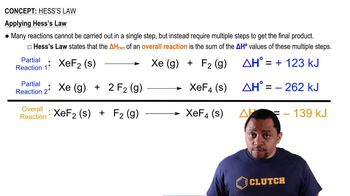
Understand that Hess's Law states that the total enthalpy change for a reaction is the same, no matter how many steps the reaction is carried out in.
To construct the enthalpy diagram, plot the enthalpy on the y-axis and the reaction progress on the x-axis.
Start with substance A at a certain enthalpy level, then draw an upward arrow to represent the enthalpy change of +30 kJ to reach substance B.
From substance B, draw another upward arrow to represent the enthalpy change of +60 kJ to reach substance C. The total enthalpy change from A to C should be the sum of the individual changes, illustrating Hess's Law.

비슷한 문제에 대한 검증된 영상 답변:

이 영상 해법은 위 문제에 도움이 된다고 튜터들이 추천한 것입니다.
영상 길이:
5m

주요 개념

질문에 올바르게 답하기 위해 반드시 이해해야 하는 핵심 개념들은 다음과 같습니다.

Enthalpy (ΔH)

Enthalpy is a thermodynamic quantity that represents the total heat content of a system. It is often expressed in kilojoules (kJ) and indicates the energy change during a chemical reaction at constant pressure. A positive ΔH value signifies an endothermic reaction, where heat is absorbed, while a negative ΔH indicates an exothermic reaction, where heat is released.
추천 영상:
가이드 코스
02:34
Enthalpy of Formation

Hess's Law

Hess's Law states that the total enthalpy change for a reaction is the same, regardless of the number of steps taken to complete the reaction. This principle allows for the calculation of enthalpy changes for complex reactions by summing the enthalpy changes of individual steps, making it a powerful tool in thermochemistry for determining reaction energies.
추천 영상:

Enthalpy Diagram

An enthalpy diagram visually represents the enthalpy changes of reactants and products in a chemical reaction. It typically shows the relative energy levels of the substances involved, with the vertical axis representing enthalpy and the horizontal axis representing the progress of the reaction. This diagram helps illustrate the energy changes and the application of Hess's Law by showing how the total enthalpy change can be derived from the individual steps.
추천 영상:
가이드 코스
02:34
Enthalpy of Formation
관련 실천
교과서 질문

A 1.800-g sample of phenol (C6H5OH) was burned in a bomb calorimeter whose total heat capacity is 11.66 kJ/°C. The temperature of the calorimeter plus contents increased from 21.36 to 26.37 °C. b. What is the heat of combustion per gram of phenol?

2
views
교과서 질문

Under constant-volume conditions, the heat of combustion of benzoic acid (C6H5COOH) is 26.38 kJ/g. A 2.760-g sample of benzoic acid is burned in a bomb calorimeter. The temperature of the calorimeter increases from 21.60 to 29.93 °C. c. Suppose that in changing samples, a portion of the water in the calorimeter were lost. In what way, if any, would this change the heat capacity of the calorimeter?

2
views
교과서 질문

A 1.800-g sample of phenol (C6H5OH) was burned in a bomb calorimeter whose total heat capacity is 11.66 kJ/°C. The temperature of the calorimeter plus contents increased from 21.36 to 26.37 °C. a. Write a balanced chemical equation for the bomb calorimeter reaction.

5
views
교과서 질문

The concentration of alcohol 1CH3CH2OH2 in blood, called the 'blood alcohol concentration' or BAC, is given in units of grams of alcohol per 100 mL of blood. The legal definition of intoxication, in many states of the United States, is that the BAC is 0.08 or higher. What is the concentration of alcohol, in terms of molarity, in blood if the BAC is 0.08?

2404
views
교과서 질문

Calculate the enthalpy change for the reaction P4O6(s) + 2 O2(g) → P4O10(s) given the following enthalpies of reaction: P4(s) + 3 O2(g) → P4O6(s) ΔH = -1640.1 kJ P4(s) + 5 O2(g) → P4O10(s) ΔH = -2940.1 kJ

1298
views
교과서 질문

From the enthalpies of reaction 2 C(s) + O2(g) → 2 CO(g) ΔH = -221.0 kJ 2 C(s) + O2(g) + 4 H2(g) → 2 CH3OH(g) ΔH = -402.4 kJ Calculate ΔH for the reaction CO(g) + 2 H2(g) → CH3OH(g)

411
views