Ch.5 - Thermochemistry
Brown - Chemistry: The Central Science 15th Edition
Brown15th EditionChemistry: The Central ScienceISBN: 9780137542970당신이 사용하는 게 아니라요?교과서 변경
5장, 문제 53b

The specific heat of ethanol, C2H5OH(l), is 2.44 J•g/K. b. Which will require more heat, increasing the temperature of 1 mol of C2H5OH(𝑙) by a certain amount or increasing the temperature of 1 mol of H2O(𝑙) by the same amount?

검증된 단계별 안내
1
Identify the specific heat capacity of both substances: Ethanol (C_2H_5OH) has a specific heat capacity of 2.44 J/g·K, and water (H_2O) has a specific heat capacity of 4.18 J/g·K.
Calculate the molar mass of ethanol (C_2H_5OH) by adding the atomic masses of its constituent atoms: 2 carbon atoms, 6 hydrogen atoms, and 1 oxygen atom.
Calculate the molar mass of water (H_2O) by adding the atomic masses of its constituent atoms: 2 hydrogen atoms and 1 oxygen atom.
Determine the mass of 1 mole of each substance using their respective molar masses.
Use the formula q = m × c × ΔT to compare the heat required for each substance, where q is the heat absorbed, m is the mass, c is the specific heat capacity, and ΔT is the change in temperature.

비슷한 문제에 대한 검증된 영상 답변:

이 영상 해법은 위 문제에 도움이 된다고 튜터들이 추천한 것입니다.
영상 길이:
2m

주요 개념

질문에 올바르게 답하기 위해 반드시 이해해야 하는 핵심 개념들은 다음과 같습니다.

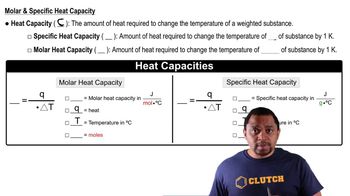
Specific Heat Capacity

Specific heat capacity is the amount of heat required to raise the temperature of one gram of a substance by one degree Celsius (or one Kelvin). It is a crucial property that varies between different substances, influencing how much heat is needed to change their temperature. In this question, the specific heat of ethanol is given, which allows for comparison with water's specific heat to determine which substance requires more heat for the same temperature change.
추천 영상:

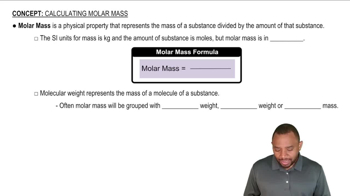
Molar Mass and Moles

Molar mass is the mass of one mole of a substance, typically expressed in grams per mole. Understanding moles is essential in chemistry as it allows for the conversion between mass and the number of particles. In this question, both ethanol and water are considered in terms of moles, which helps in calculating the total heat required to raise their temperatures based on their specific heat capacities.
추천 영상:
가이드 코스
02:11
Molar Mass Concept

Heat Transfer Equation

The heat transfer equation, often expressed as q = mcΔT, relates the heat absorbed or released (q) to the mass (m), specific heat capacity (c), and the change in temperature (ΔT). This equation is fundamental for solving problems involving temperature changes in substances. In this context, it will be used to compare the heat required for both ethanol and water when their temperatures are increased by the same amount.
추천 영상: