
교과서 질문
(b) Is this process endothermic or exothermic?
487
views

 검증된 단계별 안내
 02:19
02:19 02:19
02:19 00:50
00:50(b) Is this process endothermic or exothermic?
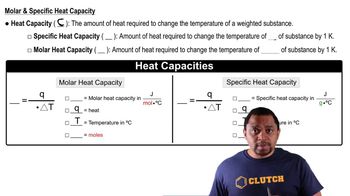
When a 5.10-g sample of solid sodium hydroxide dissolves in 100.0 g of water in a coffee-cup calorimeter (Figure 5.18), the temperature rises from 20.5 to 33.2 °C. b. Using your result from part (a), calculate ΔH (in kJ/mol NaOH) for the solution process. Assume that the specific heat of the solution is the same as that of pure water.
Consider the data about gold metal in Exercise 5.24(b). c. What is the molar heat capacity of Au(s)?
Consider the data about gold metal in Exercise 5.24(b). b. Suppose that the same amount of heat is added to two 10.0-g blocks of metal, both initially at the same temperature. One block is gold metal, and the other is iron metal. Which block will have the greater rise in temperature after addition of the heat?
The specific heat of ethanol, C2H5OH(l), is 2.44 J•g/K. b. Which will require more heat, increasing the temperature of 1 mol of C2H5OH(𝑙) by a certain amount or increasing the temperature of 1 mol of H2O(𝑙) by the same amount?
A 2.200-g sample of quinone (C6H4O2) is burned in a bomb calorimeter whose total heat capacity is 7.854 kJ/°C. The temperature of the calorimeter increases from 23.44 to 30.57 °C. (a) What is the heat of combustion per gram of quinone?