Scientists have speculated that element 126 might have a moderate stability, allowing it to be synthesized and characterized. Predict what the condensed electron configuration of this element might be.
Ch.6 - Electronic Structure of Atoms

6장, 문제 102c
In the experiment shown schematically below, a beam of neutral atoms is passed through a magnetic field. Atoms that have unpaired electrons are deflected in different directions in the magnetic field depending on the value of the electron spin quantum number. In the experiment illustrated, we envision that a beam of hydrogen atoms splits into two beams. (c) What do you think would happen if the beam of hydrogen atoms were replaced with a beam of helium atoms? Why?

검증된 단계별 안내1
Step 1: Understand the experiment setup. A beam of neutral hydrogen atoms is passed through a magnetic field created by a horseshoe magnet, causing the beam to split into two due to the electron spin quantum number.
Step 2: Recall that hydrogen atoms have one electron, which can have a spin quantum number of +1/2 or -1/2, leading to the observed splitting.
Step 3: Consider the electronic configuration of helium atoms. Helium has two electrons, both of which are paired in the 1s orbital.
Step 4: Recognize that paired electrons in helium have opposite spins, resulting in a net spin of zero. This means helium atoms do not have unpaired electrons.
Step 5: Conclude that if the beam of hydrogen atoms is replaced with a beam of helium atoms, the beam would not split in the magnetic field because helium atoms do not have unpaired electrons to interact with the magnetic field.

비슷한 문제에 대한 검증된 영상 답변:
이 영상 해법은 위 문제에 도움이 된다고 튜터들이 추천한 것입니다.
영상 길이:
1m주요 개념
질문에 올바르게 답하기 위해 반드시 이해해야 하는 핵심 개념들은 다음과 같습니다.
Electron Spin Quantum Number
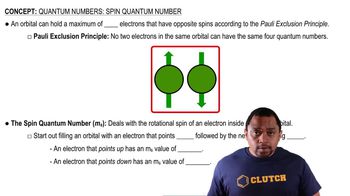
The electron spin quantum number describes the intrinsic angular momentum of electrons, which can take on values of +1/2 or -1/2. This property is crucial in determining how electrons behave in magnetic fields, as unpaired electrons will align with or against the field, leading to observable deflections in experiments like the one described.
추천 영상:
가이드 코스
Spin Quantum Number
Magnetic Deflection of Atoms
When a beam of neutral atoms passes through a magnetic field, atoms with unpaired electrons experience a force due to their magnetic moments. This results in a deflection of the atoms' paths, which can be measured to infer properties about the atoms, such as their electron configurations and the presence of unpaired electrons.
추천 영상:
가이드 코스
Magnetic Quantum Example
Comparison of Hydrogen and Helium
Hydrogen has one electron, which can be unpaired, while helium has two electrons that are paired, resulting in no net magnetic moment. If a beam of helium atoms were used instead of hydrogen, we would expect minimal or no deflection in the magnetic field, as the paired electrons in helium do not contribute to a magnetic moment that would interact with the field.
추천 영상:
가이드 코스
Hydrogenation Reactions
관련 실천
교과서 질문
1418
views
교과서 질문
In the experiment shown schematically below, a beam of neutral atoms is passed through a magnetic field. Atoms that have unpaired electrons are deflected in different directions in the magnetic field depending on the value of the electron spin quantum number. In the experiment illustrated, we envision that a beam of hydrogen atoms splits into two beams. (a) What is the significance of the observation that the single beam splits into two beams?
415
views
교과서 질문
Using the periodic table as a guide, write the condensed electron configuration and determine the number of unpaired electrons for the ground state of d. Sb
2
views