
Ch.6 - Electronic Structure of Atoms
Brown - Chemistry: The Central Science 15th Edition
Brown15th EditionChemistry: The Central ScienceISBN: 9780137542970당신이 사용하는 게 아니라요?교과서 변경
6장, 문제 100d

Using the periodic table as a guide, write the condensed electron configuration and determine the number of unpaired electrons for the ground state of d. Sb

검증된 단계별 안내
1
Identify the atomic number of antimony (Sb) from the periodic table, which is 51.
Determine the nearest noble gas preceding Sb, which is krypton (Kr) with an atomic number of 36.
Write the condensed electron configuration starting from Kr: \([\text{Kr}]\).
Continue filling the electron orbitals following the order: 5s, 4d, and 5p, until you reach the total of 51 electrons.
Count the number of unpaired electrons in the 5p orbital, as this will determine the number of unpaired electrons in the ground state of Sb.

비슷한 문제에 대한 검증된 영상 답변:

이 영상 해법은 위 문제에 도움이 된다고 튜터들이 추천한 것입니다.
영상 길이:
4m
도움이 되었나요?

주요 개념

질문에 올바르게 답하기 위해 반드시 이해해야 하는 핵심 개념들은 다음과 같습니다.

Electron Configuration

Electron configuration describes the distribution of electrons in an atom's orbitals. It is typically represented using a notation that indicates the energy levels and sublevels occupied by electrons. For example, the condensed electron configuration uses the nearest noble gas to simplify the representation, making it easier to understand the arrangement of electrons in an atom.
추천 영상:
가이드 코스
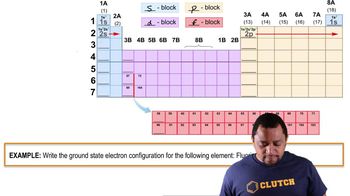
01:33
Electron Configuration Example

Periodic Table and Element Position

The periodic table organizes elements based on their atomic number and electron configurations. Each element's position indicates its electron shell and subshell filling order, which is crucial for determining its chemical properties. For antimony (Sb), located in group 15 and period 5, understanding its position helps in predicting its electron configuration and the number of unpaired electrons.
추천 영상:
가이드 코스
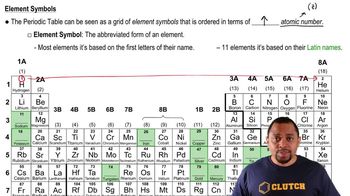
04:01
Periodic Table History

Unpaired Electrons

Unpaired electrons are those that occupy an orbital alone, without a partner of opposite spin. The presence of unpaired electrons is significant as it influences an atom's magnetic properties and reactivity. In the case of antimony, identifying the number of unpaired electrons in its ground state configuration is essential for understanding its chemical behavior and bonding characteristics.
추천 영상:
가이드 코스
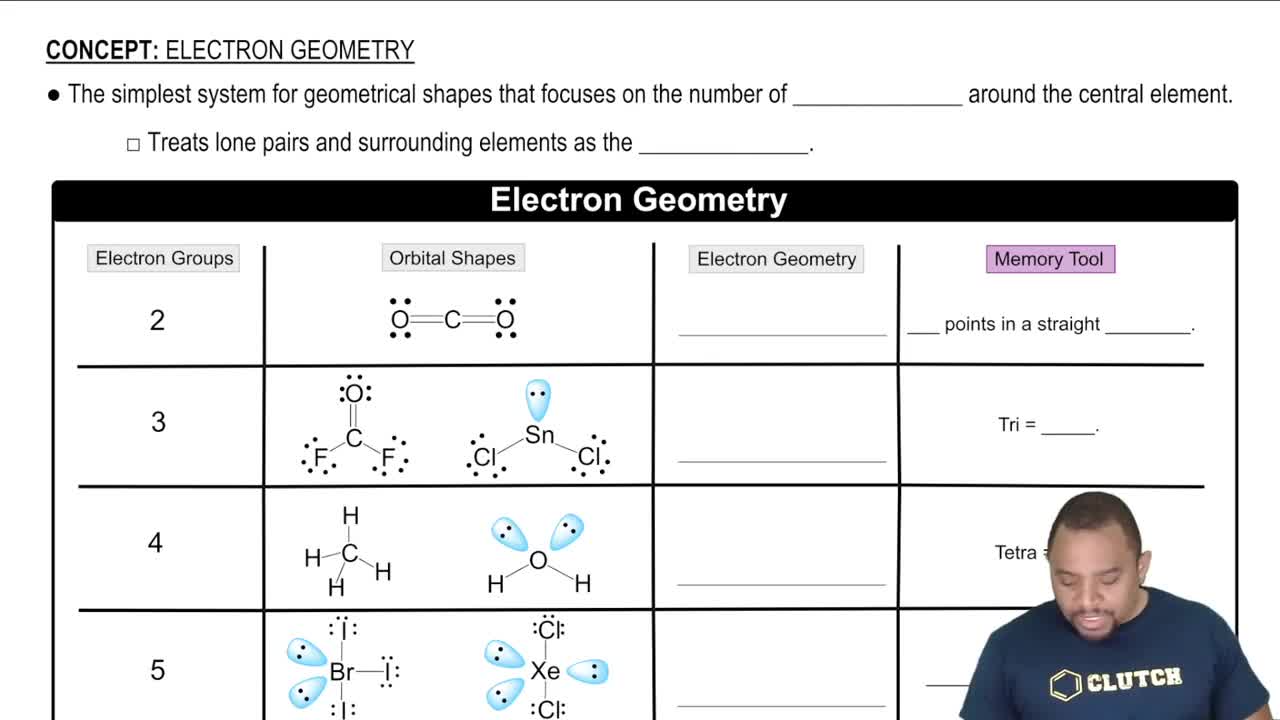
04:44
Electron Geometry
관련 실천
교과서 질문

As discussed in the A Closer Look box on 'Measurement and the Uncertainty Principle,' the essence of the uncertainty principle is that we can't make a measurement without disturbing the system that we are measuring. (a) Why can't we measure the position of a subatomic particle without disturbing it?

479
views
교과서 질문

Scientists have speculated that element 126 might have a moderate stability, allowing it to be synthesized and characterized. Predict what the condensed electron configuration of this element might be.

1418
views
교과서 질문

In the experiment shown schematically below, a beam of neutral atoms is passed through a magnetic field. Atoms that have unpaired electrons are deflected in different directions in the magnetic field depending on the value of the electron spin quantum number. In the experiment illustrated, we envision that a beam of hydrogen atoms splits into two beams. (a) What is the significance of the observation that the single beam splits into two beams?

415
views
교과서 질문

The Chemistry and Life box in Section 6.7 described the techniques called NMR and MRI. (c) When the 450-MHz photon is absorbed, does it change the spin of the electron or the proton on a hydrogen atom?

401
views
교과서 질문

In the experiment shown schematically below, a beam of neutral atoms is passed through a magnetic field. Atoms that have unpaired electrons are deflected in different directions in the magnetic field depending on the value of the electron spin quantum number. In the experiment illustrated, we envision that a beam of hydrogen atoms splits into two beams. (c) What do you think would happen if the beam of hydrogen atoms were replaced with a beam of helium atoms? Why?

597
views
1
rank