
Ch.6 - Electronic Structure of Atoms
Brown - Chemistry: The Central Science 15th Edition
Brown15th EditionChemistry: The Central ScienceISBN: 9780137542970당신이 사용하는 게 아니라요?교과서 변경
6장, 문제 99

Suppose that the spin quantum number, ms, could have three allowed values instead of two. How would this affect the number of elements in the first four rows of the periodic table?

검증된 단계별 안내
1
Step 1: Understand the role of the spin quantum number (m_s) in electron configuration. The spin quantum number describes the intrinsic angular momentum of an electron, and traditionally it can have two values: +1/2 or -1/2.
Step 2: Recognize that the number of elements in a period of the periodic table is determined by the number of available electron states in the atomic orbitals for that period. Each orbital can hold a maximum of two electrons with opposite spins.
Step 3: Consider how the introduction of a third spin state would affect the capacity of each orbital. With three possible spin states, each orbital could now hold three electrons instead of two.
Step 4: Calculate the new number of elements for each of the first four periods. For example, the first period has 1s orbitals, which traditionally hold 2 electrons, but with three spin states, it would hold 3 electrons, thus increasing the number of elements in that period.
Step 5: Apply this logic to the second, third, and fourth periods, considering the types and numbers of orbitals (s, p, d) available in each period, and calculate the total number of elements for each period with the new spin state configuration.

주요 개념

질문에 올바르게 답하기 위해 반드시 이해해야 하는 핵심 개념들은 다음과 같습니다.

Quantum Numbers

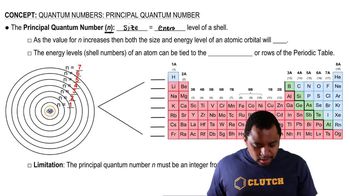
Quantum numbers are sets of numerical values that describe the unique quantum state of an electron in an atom. The four quantum numbers include the principal quantum number (n), azimuthal quantum number (l), magnetic quantum number (m_l), and spin quantum number (m_s). Each electron in an atom is characterized by these numbers, which determine its energy level, shape, orientation, and spin.
추천 영상:
가이드 코스
02:55
Principal Quantum Number

Electron Configuration

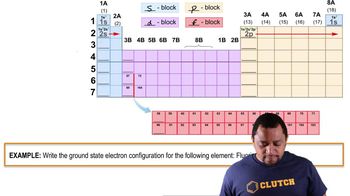
Electron configuration refers to the distribution of electrons in an atom's orbitals. The arrangement of electrons is governed by the Pauli Exclusion Principle, which states that no two electrons can have the same set of quantum numbers. If the spin quantum number (m_s) had three allowed values, it would allow for more electrons to occupy the same orbital, thereby altering the electron configurations of elements.
추천 영상:
가이드 코스
01:33
Electron Configuration Example

Periodic Table Structure

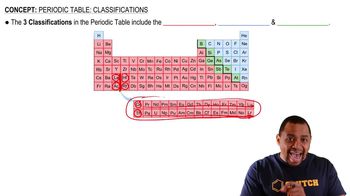
The periodic table is organized based on the atomic number and electron configurations of elements, which dictate their chemical properties. Each row (or period) corresponds to the filling of electron shells. If the spin quantum number had three values, it would increase the maximum number of electrons that can occupy each orbital, potentially leading to more elements in the first four rows, as more electrons could be accommodated in the same energy levels.
추천 영상:
가이드 코스
02:40
Periodic Table Classifications