
Ch.8 - Basic Concepts of Chemical Bonding
Brown - Chemistry: The Central Science 15th Edition
Brown15th EditionChemistry: The Central ScienceISBN: 9780137542970당신이 사용하는 게 아니라요?교과서 변경
8장, 문제 90b

A major challenge in implementing the 'hydrogen economy' is finding a safe, lightweight, and compact way of storing hydrogen for use as a fuel. The hydrides of light metals are attractive for hydrogen storage because they can store a high weight percentage of hydrogen in a small volume. For example, NaAlH4 can release 5.6% of its mass as H2 upon decomposing to NaH(s), Al(s), and H2(g). NaAlH4 possesses both covalent bonds, which hold polyatomic anions together, and ionic bonds. (b) Which element in NaAlH4 is the most electronegative? Which one is the least electronegative? Which element in NaAlH4 is the least electronegative?

검증된 단계별 안내
1
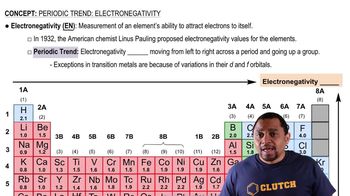
1. To determine the most and least electronegative elements in NaAlH4, we need to refer to the periodic table. Electronegativity is a measure of the ability of an atom to attract electrons. It increases from left to right across a period and decreases from top to bottom within a group.
2. In the compound NaAlH4, we have the elements Sodium (Na), Aluminum (Al), and Hydrogen (H).
3. Looking at the periodic table, we can see that Hydrogen (H) is the most electronegative element among these three. This is because it is located at the top right of the periodic table (excluding the noble gases).
4. On the other hand, Sodium (Na) is the least electronegative element in NaAlH4. This is because it is located at the far left of the periodic table, where electronegativity values are the lowest.
5. Therefore, Hydrogen (H) is the most electronegative element and Sodium (Na) is the least electronegative element in the compound NaAlH4.

비슷한 문제에 대한 검증된 영상 답변:

이 영상 해법은 위 문제에 도움이 된다고 튜터들이 추천한 것입니다.
영상 길이:
3m
도움이 되었나요?

주요 개념

질문에 올바르게 답하기 위해 반드시 이해해야 하는 핵심 개념들은 다음과 같습니다.

Electronegativity

Electronegativity is a measure of an atom's ability to attract and hold onto electrons in a chemical bond. It is a key factor in determining the nature of bonds formed between atoms, influencing molecular polarity and reactivity. The Pauling scale is commonly used to quantify electronegativity, with fluorine being the most electronegative element.
추천 영상:
가이드 코스
02:10
Electronegativity Trends

Covalent and Ionic Bonds

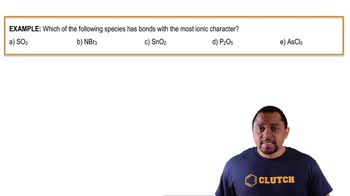
Covalent bonds occur when two atoms share electrons, typically between nonmetals, leading to the formation of molecules. In contrast, ionic bonds form when one atom donates electrons to another, resulting in the attraction between positively and negatively charged ions. Understanding these bond types is crucial for analyzing the structure and properties of compounds like NaAlH4.
추천 영상:
가이드 코스
01:16
Chemical Bonds Example 1

Hydrides

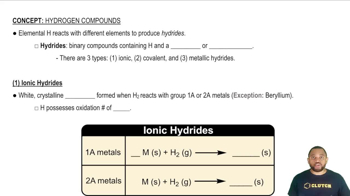
Hydrides are compounds formed between hydrogen and other elements, often metals. They can exist in various forms, including ionic and covalent hydrides, and are significant in hydrogen storage technologies. Light metal hydrides, such as NaAlH4, are particularly noted for their ability to absorb and release hydrogen gas, making them valuable for applications in the hydrogen economy.
추천 영상:
관련 실천
교과서 질문

A major challenge in implementing the 'hydrogen economy' is finding a safe, lightweight, and compact way of storing hydrogen for use as a fuel. The hydrides of light metals are attractive for hydrogen storage because they can store a high weight percentage of hydrogen in a small volume. For example, NaAlH4 can release 5.6% of its mass as H2 upon decomposing to NaH(s), Al(s), and H2(g). NaAlH4 possesses both covalent bonds, which hold polyatomic anions together, and ionic bonds. (c) Based on electronegativity differences, predict the identity of the polyatomic anion. Draw a Lewis structure for this ion.

424
views
교과서 질문

(c) The measured dipole moment of BrCl is 0.57 D. If you assume the bond length in BrCl is the sum of the atomic radii, what are the partial charges on the atoms in BrCl using the experimental dipole moment?

951
views
1
rank
교과서 질문

Structures A, B, and C show the connectivity of the atoms in three different molecules that are isomers of C3H4O. By completing the Lewis structures of these molecules, complete the information in the following table:

Isomer A Isomer B Isomer C

Number of single bonds

Number of double bonds

Number of triple bonds

Number of nonbonding pairs

교과서 질문

The substance chlorine monoxide, ClO(g), is important in atmospheric processes that lead to depletion of the ozone layer. The ClO molecule has an experimental dipole moment of 1.24 D, and the Cl—O bond length is 160 pm. (b) Based on the electronegativities of the elements, which atom would you expect to have a partial negative charge in the ClO molecule?

987
views
교과서 질문

(b) Using these partial charges and the atomic radii given in Figure 7.8, estimate the dipole moment of the molecule.

881
views
교과서 질문

A major challenge in implementing the 'hydrogen economy' is finding a safe, lightweight, and compact way of storing hydrogen for use as a fuel. The hydrides of light metals are attractive for hydrogen storage because they can store a high weight percentage of hydrogen in a small volume. For example, NaAlH4 can release 5.6% of its mass as H2 upon decomposing to NaH(s), Al(s), and H2(g). NaAlH4 possesses both covalent bonds, which hold polyatomic anions together, and ionic bonds. (d) What is the formal charge on hydrogen in the polyatomic ion?

338
views