
교과서 질문
Using Figures 9.39 and 9.43 as guides, draw the molecular-orbital electron configuration for (d) Ne22+. In each case indicate whether the addition of an electron to the ion would increase or decrease the bond order of the species.
2
views

 검증된 단계별 안내
 00:36
00:36
 00:59
00:59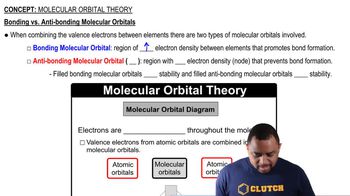 03:06
03:06Using Figures 9.39 and 9.43 as guides, draw the molecular-orbital electron configuration for (d) Ne22+. In each case indicate whether the addition of an electron to the ion would increase or decrease the bond order of the species.
Determine the electron configurations for CN+, CN, and CN-. (a) Which species has the strongest C¬N bond?
a. Which of the following is expected to be paramagnetic: Ne, Li2, Li2+, N2, N2+, N22−? b. For each of the substances in part (a) that is paramagnetic, determine the number of unpaired electrons it has.
If we assume that the energy-level diagrams for homonuclear diatomic molecules shown in Figure 9.43 can be applied to heteronuclear diatomic molecules and ions, predict the bond order and magnetic behavior of d. NeF+
Determine whether each of the following statements about diamagnetism and paramagnetism is true or false:
a. A diamagnetic substance is weakly repelled from a magnetic field.
b. A substance with unpaired electrons will be diamagnetic.
c. A paramagnetic substance is attracted to a magnetic field.
d. The O2 molecule is paramagnetic.
Determine the electron configurations for CN+, CN, and CN-. b. Which species, if any, is paramagnetic?