Ch.9 - Molecular Geometry and Bonding Theories
Brown - Chemistry: The Central Science 15th Edition
Brown15th EditionChemistry: The Central ScienceISBN: 9780137542970당신이 사용하는 게 아니라요?교과서 변경
9장, 문제 76

a. Based on its molecular-orbital diagram, what is the bond order of the O2 molecule?
b. What is the expected bond order for the peroxide ion, O22−?
c. What is the expected bond order for the superoxide ion, O2−?
d. From shortest to longest, predict the ordering of the bond lengths for O2, O22−, and O2−.
e. From weakest to strongest, predict the ordering of the bond strengths for O2, O22−, and O2−.

검증된 단계별 안내
1
Step 1: Understand the concept of bond order. Bond order is calculated using the formula: \( \text{Bond Order} = \frac{\text{Number of bonding electrons} - \text{Number of antibonding electrons}}{2} \).
Step 2: Determine the bond order for \( \text{O}_2 \). The molecular orbital configuration for \( \text{O}_2 \) is \( \sigma_{1s}^2 \sigma^*_{1s}^2 \sigma_{2s}^2 \sigma^*_{2s}^2 \sigma_{2p_z}^2 \pi_{2p_x}^2 \pi_{2p_y}^2 \pi^*_{2p_x}^1 \pi^*_{2p_y}^1 \). Calculate the bond order using the formula.
Step 3: Calculate the bond order for the peroxide ion \( \text{O}_2^{2-} \). Add two electrons to the antibonding orbitals of \( \text{O}_2 \) and recalculate the bond order.
Step 4: Calculate the bond order for the superoxide ion \( \text{O}_2^- \). Add one electron to the antibonding orbitals of \( \text{O}_2 \) and recalculate the bond order.
Step 5: Compare the bond orders to predict the bond lengths and strengths. Higher bond order generally means shorter bond length and stronger bond. Arrange \( \text{O}_2 \), \( \text{O}_2^{2-} \), and \( \text{O}_2^- \) in order of bond length and strength based on their bond orders.

비슷한 문제에 대한 검증된 영상 답변:

이 영상 해법은 위 문제에 도움이 된다고 튜터들이 추천한 것입니다.
영상 길이:
7m
도움이 되었나요?

주요 개념

질문에 올바르게 답하기 위해 반드시 이해해야 하는 핵심 개념들은 다음과 같습니다.

Molecular Orbital Theory

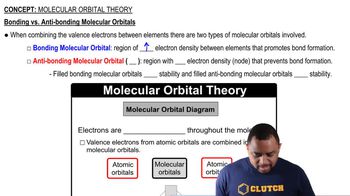
Molecular Orbital Theory describes how atomic orbitals combine to form molecular orbitals, which can be occupied by electrons. In this theory, electrons are delocalized over the entire molecule, and the bond order can be calculated as the difference between the number of bonding and antibonding electrons divided by two. This concept is crucial for understanding the stability and properties of molecules like O2 and its ions.
추천 영상:
가이드 코스
03:06
Molecular Orbital Theory

Bond Order

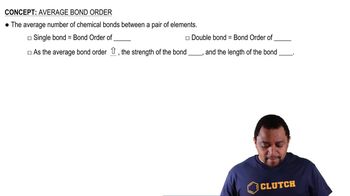
Bond order is a measure of the number of chemical bonds between a pair of atoms. It is calculated using the formula: Bond Order = (Number of bonding electrons - Number of antibonding electrons) / 2. A higher bond order indicates a stronger bond and typically correlates with shorter bond lengths, making it essential for predicting the stability and reactivity of molecules and ions.
추천 영상:
가이드 코스
00:36
Average Bond Order

Bond Length and Bond Strength

Bond length refers to the distance between the nuclei of two bonded atoms, while bond strength indicates the energy required to break that bond. Generally, shorter bonds are stronger due to the increased overlap of atomic orbitals. Understanding the relationship between bond order, bond length, and bond strength is vital for predicting the physical properties of molecules like O2, O2−, and O22−.
추천 영상:
가이드 코스
00:36
Average Bond Order