Ch.11 - Liquids & Phase Changes
McMurry - Chemistry 8th Edition
McMurry8th EditionChemistryISBN: 9781292336145당신이 사용하는 게 아니라요?교과서 변경
11장, 문제 2

Which organic compound has the lowest viscosity? (LO 11.2)

검증된 단계별 안내
1
Understand that viscosity is a measure of a fluid's resistance to flow. In general, the lower the viscosity, the more easily the fluid flows.
Recognize that in organic compounds, viscosity is influenced by molecular size, shape, and intermolecular forces such as hydrogen bonding, dipole-dipole interactions, and London dispersion forces.
Consider that smaller molecules with less complex structures and weaker intermolecular forces tend to have lower viscosities.
Identify that alkanes, which are simple hydrocarbons with only single bonds, typically have lower viscosities compared to more complex organic compounds like alcohols or carboxylic acids.
Conclude that among a group of organic compounds, the one with the smallest molecular size and weakest intermolecular forces is likely to have the lowest viscosity.

비슷한 문제에 대한 검증된 영상 답변:

이 영상 해법은 위 문제에 도움이 된다고 튜터들이 추천한 것입니다.
영상 길이:
3m
도움이 되었나요?

주요 개념

질문에 올바르게 답하기 위해 반드시 이해해야 하는 핵심 개념들은 다음과 같습니다.

Viscosity

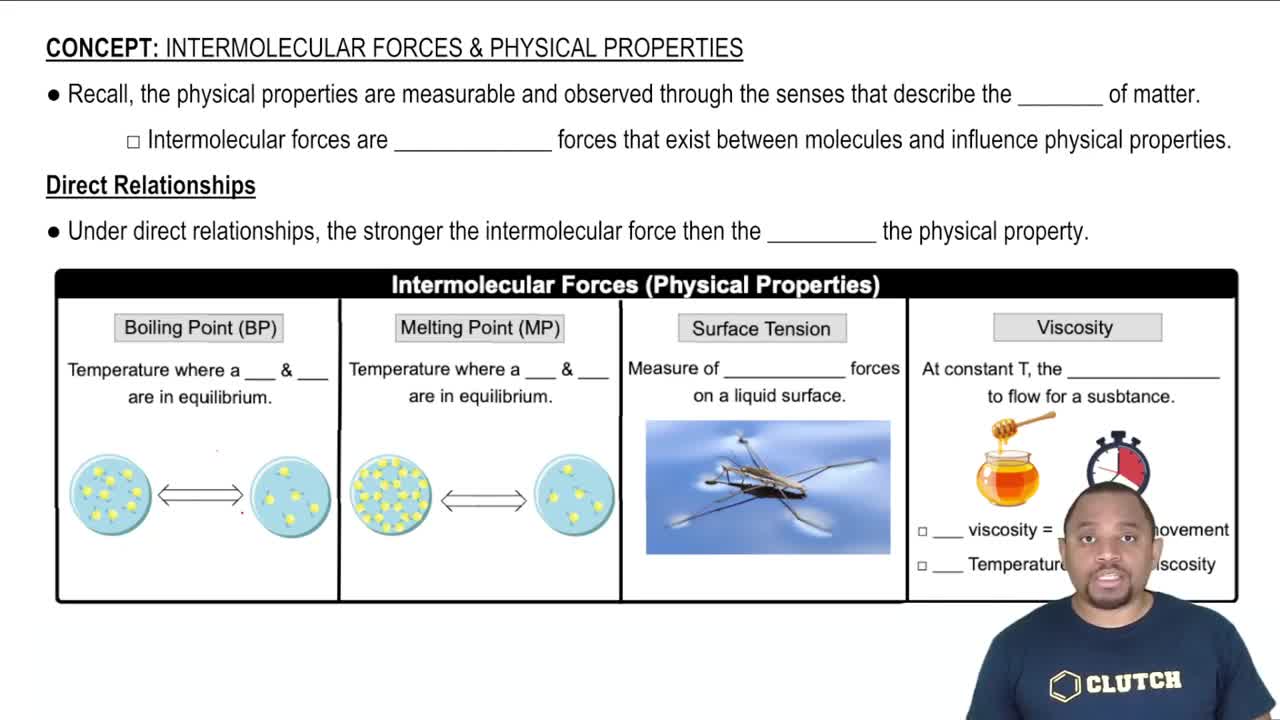
Viscosity is a measure of a fluid's resistance to flow. It describes how thick or sticky a liquid is, with higher viscosity indicating a greater resistance to flow. In organic compounds, factors such as molecular size, shape, and intermolecular forces influence viscosity. Understanding these factors is essential for predicting which compounds will have lower or higher viscosities.
추천 영상:
가이드 코스
03:13
Intermolecular Forces and Properties

Intermolecular Forces

Intermolecular forces are the attractive forces between molecules that affect their physical properties, including viscosity. These forces include hydrogen bonding, dipole-dipole interactions, and London dispersion forces. Compounds with weaker intermolecular forces generally exhibit lower viscosities, as they can flow more freely compared to those with stronger forces.
추천 영상:
가이드 코스
01:59
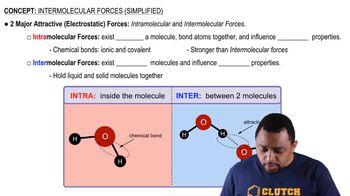
Intermolecular vs Intramolecular Forces

Molecular Structure

The molecular structure of an organic compound, including its size, shape, and functional groups, plays a crucial role in determining its viscosity. Larger molecules or those with complex branching may have higher viscosities due to increased surface area and stronger intermolecular interactions. Conversely, smaller, more linear molecules tend to have lower viscosities, making molecular structure a key factor in viscosity comparisons.
추천 영상:
가이드 코스
02:08
Molecular Formula
관련 실천
교과서 질문
Which molecule has polar bonds but is nonpolar? (LO 8.6) (a) SF6 (b) SF2 (c) F2 (d) NF3
835
views
교과서 질문
Consider a compound that has a melting point at 65 °C and a boiling point at 175 °C. Which of the following images represents a heating curve for the compound from 40 °C to 200 °C? (LO 11.5)
700
views
1
rank
교과서 질문
Three identical tubes are filled with different liquids; water, ethylene glycol, and olive oil. A small steel sphere was dropped into the tube, and the time it took to fall to the bottom was recorded. Which property of liquids is responsible for the differences in time for the sphere to fall through the liquid? (LO 11.1)(a) Surface tension(b) Boiling point(c) Viscosity(d) Vapor pressure
430
views
교과서 질문
What types of intermolecular forces exist in a sample of acetone?(LO 8.8)

(a) Dispersion forces (b) Dispersion forces and dipole–dipole forces (c) Dipole–dipole forces (d) Dispersion forces, dipole–dipole forces, and hydrogen bonding
1240
views