Ch.12 - Solids and Solid-State Materials
McMurry - Chemistry 8th Edition
McMurry8th EditionChemistryISBN: 9781292336145당신이 사용하는 게 아니라요?교과서 변경
12장, 문제 57

Carbon and oxygen combine to form the molecular compound CO2, while silicon and oxygen combine to form a covalent network solid with the formula unit SiO2. Explain the difference in bonding between the two group 4A elements and oxygen.

검증된 단계별 안내
1
Step 1: Understand the nature of the elements involved. Carbon (C) and Silicon (Si) are both in Group 4A of the periodic table, meaning they have four valence electrons. Oxygen (O) is in Group 6A, meaning it has six valence electrons.
Step 2: Understand the bonding in CO2. Carbon forms double bonds with each of the two oxygen atoms, sharing two pairs of electrons with each oxygen. This results in a molecular compound where the atoms are held together by covalent bonds.
Step 3: Understand the bonding in SiO2. Silicon also forms covalent bonds with oxygen, but in this case, the bonding leads to a covalent network solid. Each silicon atom is bonded to four oxygen atoms, and each oxygen atom is bonded to two silicon atoms. This forms a three-dimensional network structure.
Step 4: Understand the difference in bonding. The difference in bonding between CO2 and SiO2 is due to the difference in the size and the electron configuration of the carbon and silicon atoms. Silicon atoms are larger and can accommodate more bonds, leading to the formation of a covalent network solid. Carbon atoms are smaller and form a simple molecular compound.
Step 5: Remember that the type of bonding has a significant impact on the properties of the substance. For example, CO2 is a gas at room temperature, while SiO2 is a solid with a high melting point.

비슷한 문제에 대한 검증된 영상 답변:

이 영상 해법은 위 문제에 도움이 된다고 튜터들이 추천한 것입니다.
영상 길이:
9m
도움이 되었나요?

주요 개념

질문에 올바르게 답하기 위해 반드시 이해해야 하는 핵심 개념들은 다음과 같습니다.

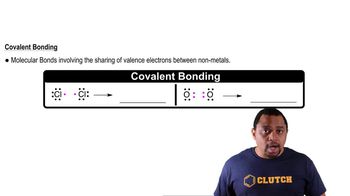
Covalent Bonding

Covalent bonding occurs when two atoms share electrons to achieve a full outer shell, leading to the formation of molecules. In the case of CO2, carbon shares electrons with two oxygen atoms, resulting in a linear molecular structure. This type of bonding is characterized by the specific arrangement of atoms and the presence of distinct molecular properties.
추천 영상:

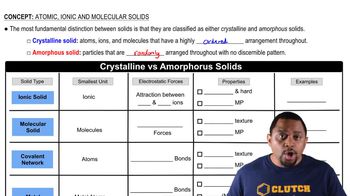
Network Covalent Solids

Network covalent solids, like SiO2, consist of a continuous network of covalent bonds extending throughout the material. In SiO2, each silicon atom is bonded to four oxygen atoms in a tetrahedral arrangement, creating a rigid three-dimensional structure. This results in high melting points and hardness, distinguishing them from molecular compounds.
추천 영상:
가이드 코스
04:13
Crystalline vs Amorphous Solids

Differences in Elemental Properties

The differences in bonding between carbon and silicon with oxygen stem from their positions in the periodic table. Carbon, a nonmetal, forms discrete molecular compounds like CO2, while silicon, a metalloid, tends to form extensive covalent networks. This variance in bonding behavior is influenced by factors such as electronegativity and atomic size, affecting how these elements interact with oxygen.
추천 영상:
가이드 코스
02:35
Elemental Forms of Elements