Ch.13 - Solutions & Their Properties
McMurry - Chemistry 8th Edition
McMurry8th EditionChemistryISBN: 9781292336145당신이 사용하는 게 아니라요?교과서 변경
13장, 문제 40

Classify the strongest type of intermolecular force in the follow- ing interactions: solvent–solvent, solvent–solute, and solute– solute when solid iodine 1I22 is placed in the water. Based on these interactions, predict whether I2 is soluble in water.

검증된 단계별 안내
1
Identify the types of molecules involved: Iodine (I2) is a nonpolar molecule, while water (H2O) is a polar molecule.
Determine the strongest intermolecular force for solvent-solvent interactions: Water molecules interact with each other primarily through hydrogen bonding, which is a strong type of dipole-dipole interaction.
Determine the strongest intermolecular force for solute-solute interactions: Iodine molecules interact with each other through London dispersion forces, which are the weakest type of intermolecular forces.
Determine the strongest intermolecular force for solvent-solute interactions: When iodine is placed in water, the interaction between iodine and water is primarily through dipole-induced dipole forces, which are weaker than hydrogen bonds.
Predict the solubility of I2 in water: Since the interactions between iodine and water are weaker than the interactions within water itself, iodine is not very soluble in water.

비슷한 문제에 대한 검증된 영상 답변:

이 영상 해법은 위 문제에 도움이 된다고 튜터들이 추천한 것입니다.
영상 길이:
2m
도움이 되었나요?

주요 개념

질문에 올바르게 답하기 위해 반드시 이해해야 하는 핵심 개념들은 다음과 같습니다.

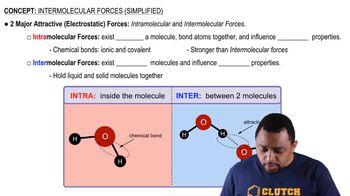
Intermolecular Forces

Intermolecular forces are the forces of attraction or repulsion between molecules. They include hydrogen bonding, dipole-dipole interactions, and London dispersion forces. Understanding these forces is crucial for predicting the behavior of substances in different environments, such as solubility in solvents.
추천 영상:
가이드 코스
01:59
Intermolecular vs Intramolecular Forces

Solubility Principles

Solubility refers to the ability of a solute to dissolve in a solvent, which is influenced by the nature of both the solute and solvent. The principle 'like dissolves like' indicates that polar solvents tend to dissolve polar solutes, while nonpolar solvents dissolve nonpolar solutes. This concept is essential for predicting the solubility of iodine in water.
추천 영상:
가이드 코스
02:05
Uncertainty Principle Formula

Iodine and Water Interactions

Iodine (I2) is a nonpolar molecule, while water (H2O) is a polar solvent. The interactions between iodine and water involve weaker London dispersion forces, which are not strong enough to overcome the hydrogen bonding present in water. This difference in polarity explains why iodine is not soluble in water.
추천 영상:
가이드 코스
01:23
Reaction with Water