Ch.20 - Nuclear Chemistry
McMurry - Chemistry 8th Edition
McMurry8th EditionChemistryISBN: 9781292336145당신이 사용하는 게 아니라요?교과서 변경
20장, 문제 27

What is the difference between an a particle and a helium atom?

검증된 단계별 안내
1
An alpha particle and a helium atom are similar in that they both contain two protons and two neutrons. However, there are key differences between the two.
An alpha particle, often represented as \(^4_2\)He or \(^4_2\alpha\), is a type of ionizing radiation. It is a helium nucleus that has been stripped of its two electrons, leaving it with a +2 charge.
A helium atom, on the other hand, is a stable atom that includes not only the two protons and two neutrons, but also two electrons. This gives it a neutral charge.
The presence or absence of these electrons is what primarily differentiates an alpha particle from a helium atom. The helium atom is electrically neutral, while the alpha particle is positively charged.
Another difference is their behavior. Alpha particles are typically produced in the process of radioactive decay and can be harmful if ingested or inhaled, while helium atoms are generally stable and safe.

비슷한 문제에 대한 검증된 영상 답변:

이 영상 해법은 위 문제에 도움이 된다고 튜터들이 추천한 것입니다.
영상 길이:
3m
도움이 되었나요?

주요 개념

질문에 올바르게 답하기 위해 반드시 이해해야 하는 핵심 개념들은 다음과 같습니다.

Alpha Particle

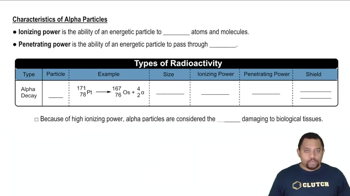
An alpha particle is a type of subatomic particle consisting of two protons and two neutrons, which is essentially the nucleus of a helium atom. It is emitted during radioactive decay processes, such as alpha decay, and carries a positive charge. Due to its relatively large mass and charge, alpha particles have low penetration power and can be stopped by a sheet of paper or human skin.
추천 영상:
가이드 코스
02:48
Characteristics of Alpha Particles

Helium Atom

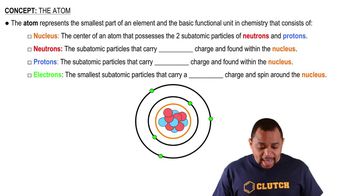
A helium atom is a neutral atom that consists of two protons, two neutrons, and two electrons. It is the second lightest and second most abundant element in the universe, primarily found in stars. Unlike an alpha particle, a helium atom is stable and does not undergo radioactive decay under normal conditions, making it a fundamental building block in various chemical and physical processes.
추천 영상:

Nuclear Stability

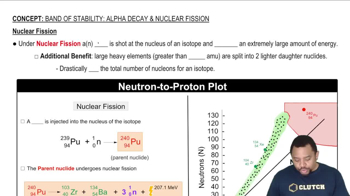
Nuclear stability refers to the balance of forces within an atomic nucleus that determines whether it will remain intact or undergo decay. Stable nuclei, like that of a helium atom, have a favorable ratio of protons to neutrons, which helps to counteract the repulsive forces between positively charged protons. In contrast, alpha particles are often produced by unstable nuclei as they seek to achieve stability through the emission of these particles.
추천 영상:
가이드 코스
03:29
Band of Stability: Nuclear Fission