
Ch.21 - Transition Elements and Coordination Chemistry
McMurry - Chemistry 8th Edition
McMurry8th EditionChemistryISBN: 9781292336145당신이 사용하는 게 아니라요?교과서 변경
21장, 문제 7

Identify the false statement about the structures of the complex ion [Fe(en)2Cl2]+ shown below.
(a) Structures I and II are cis-trans isomers.
(b) Structures I and IV are cis-trans isomers.
(c) Structures I and III are enantiomers.
(d) Structures II and IV are enantiomers.

검증된 단계별 안내
1
Identify the ligand arrangement around the central metal ion in each structure to determine the type of isomerism or stereochemistry.
Understand the concept of cis-trans isomerism: cis isomers have similar groups on the same side, while trans isomers have them on opposite sides.
Recognize enantiomers as non-superimposable mirror images, typically involving chiral centers.
Compare structures I and II, and I and IV to check if similar groups are on the same or opposite sides to verify if they are cis-trans isomers.
Compare structures I and III, and II and IV to determine if they are mirror images of each other, which would indicate they are enantiomers.

비슷한 문제에 대한 검증된 영상 답변:

이 영상 해법은 위 문제에 도움이 된다고 튜터들이 추천한 것입니다.
도움이 되었나요?

주요 개념

질문에 올바르게 답하기 위해 반드시 이해해야 하는 핵심 개념들은 다음과 같습니다.

Cis-Trans Isomerism

Cis-trans isomerism occurs in coordination compounds where ligands can occupy different spatial arrangements around a central metal ion. In a cis configuration, similar ligands are adjacent to each other, while in a trans configuration, they are opposite. This concept is crucial for understanding the geometric differences in the structures of complex ions.
추천 영상:
가이드 코스
3:33
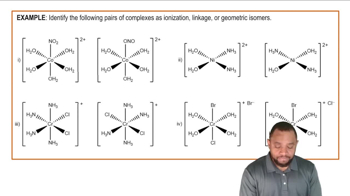
Isomerism in Coordination Complexes Example

Enantiomers

Enantiomers are a type of stereoisomer that are non-superimposable mirror images of each other. They typically arise in chiral environments, such as when a metal ion is coordinated to ligands in a way that creates asymmetry. Recognizing enantiomers is essential for determining the optical activity and specific interactions of complex ions.
추천 영상:
가이드 코스
02:33
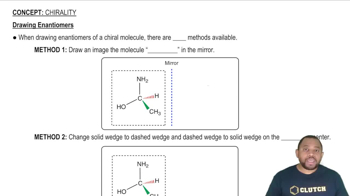
Drawing Enantiomers

Coordination Chemistry

Coordination chemistry studies the structures and properties of complex ions formed by metal ions and surrounding ligands. The arrangement of ligands around the metal can lead to various geometric configurations, influencing the chemical behavior and reactivity of the complex. Understanding coordination chemistry is fundamental for analyzing the relationships between different structural forms of complex ions.
추천 영상:
가이드 코스
00:27
Coordination Numbers