Ch.22 - The Main Group Elements
McMurry - Chemistry 8th Edition
McMurry8th EditionChemistryISBN: 9781292336145당신이 사용하는 게 아니라요?교과서 변경
22장, 문제 22.92

Draw the electron-dot structure for CO, CO2, and CO32–, and predict which substance will have the strongest carbon–oxygen bond.

검증된 단계별 안내
1
Identify the total number of valence electrons for each molecule or ion. For CO, carbon has 4 valence electrons and oxygen has 6, totaling 10 electrons. For CO_2, carbon has 4 and each oxygen has 6, totaling 16 electrons. For CO_3^{2-}, carbon has 4, each oxygen has 6, and the 2- charge adds 2 more electrons, totaling 24 electrons.
Draw the Lewis structure for CO by placing carbon and oxygen next to each other. Use a triple bond between carbon and oxygen to satisfy the octet rule, and place any remaining electrons as lone pairs on the oxygen atom.
Draw the Lewis structure for CO_2 by placing carbon in the center with double bonds to each oxygen. Ensure each atom satisfies the octet rule, with carbon having 8 electrons and each oxygen having 8 electrons.
Draw the Lewis structure for CO_3^{2-} by placing carbon in the center with single bonds to each oxygen. Distribute the remaining electrons to satisfy the octet rule for each oxygen. Use resonance structures to show the delocalization of electrons, indicating that the double bond can be with any of the three oxygens.
Compare the bond orders: CO has a triple bond (bond order of 3), CO_2 has double bonds (bond order of 2), and CO_3^{2-} has resonance structures with an average bond order of 1.33. The strongest bond is the one with the highest bond order, which is the triple bond in CO.

비슷한 문제에 대한 검증된 영상 답변:

이 영상 해법은 위 문제에 도움이 된다고 튜터들이 추천한 것입니다.
도움이 되었나요?

주요 개념

질문에 올바르게 답하기 위해 반드시 이해해야 하는 핵심 개념들은 다음과 같습니다.

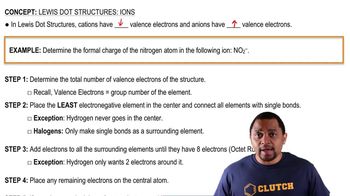
Electron-Dot Structures

Electron-dot structures, also known as Lewis structures, represent the valence electrons of atoms within a molecule. They illustrate how electrons are shared or transferred between atoms, helping to visualize bonding and lone pairs. For CO, CO2, and CO3^2–, drawing these structures reveals the arrangement of electrons and the types of bonds formed, which are crucial for understanding molecular geometry and reactivity.
추천 영상:
가이드 코스
04:28
Lewis Dot Structures: Ions

Bond Order

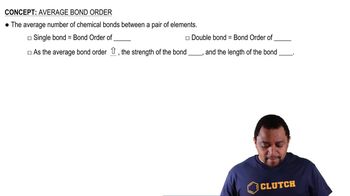
Bond order is a concept that indicates the number of chemical bonds between a pair of atoms. It is calculated as the difference between the number of bonding and antibonding electrons divided by two. Higher bond orders generally correlate with stronger bonds; thus, analyzing the bond order in CO, CO2, and CO3^2– will help predict which carbon-oxygen bond is the strongest based on the number of shared electron pairs.
추천 영상:
가이드 코스
00:36
Average Bond Order

Resonance Structures

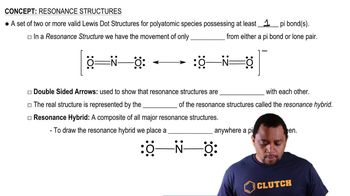
Resonance structures are different ways of drawing the same molecule that illustrate the delocalization of electrons. In molecules like CO3^2–, resonance indicates that the actual structure is a hybrid of these forms, affecting bond lengths and strengths. Understanding resonance is essential for predicting the stability and reactivity of the molecule, as it influences the effective bond order and the strength of the carbon-oxygen bonds.
추천 영상:
가이드 코스
01:42
Resonance Structures