Ch.22 - The Main Group Elements
McMurry - Chemistry 8th Edition
McMurry8th EditionChemistryISBN: 9781292336145당신이 사용하는 게 아니라요?교과서 변경
22장, 문제 16

Give one example from main-group chemistry that illustrates each of the following descriptions. (a) Covalent network solid (b) Disproportionation reaction (c) Paramagnetic oxide (d) Lewis acid (e) Amphoteric oxide (f) Semiconductor (g) Strong oxidizing agent (h) Allotropes

검증된 단계별 안내
1
(a) Covalent network solid: Consider silicon dioxide (SiO₂), which forms a three-dimensional network of covalent bonds, resulting in a very hard and high melting point solid.
(b) Disproportionation reaction: An example is the reaction of chlorine gas in water, where chlorine is both reduced and oxidized: Cl₂ + H₂O → HCl + HClO.
(c) Paramagnetic oxide: Manganese(IV) oxide (MnO₂) is paramagnetic due to the presence of unpaired electrons in the d-orbitals of manganese.
(d) Lewis acid: Aluminum chloride (AlCl₃) acts as a Lewis acid because it can accept an electron pair, often forming a complex with a Lewis base.
(e) Amphoteric oxide: Zinc oxide (ZnO) can react with both acids and bases, demonstrating its amphoteric nature.

주요 개념

질문에 올바르게 답하기 위해 반드시 이해해야 하는 핵심 개념들은 다음과 같습니다.

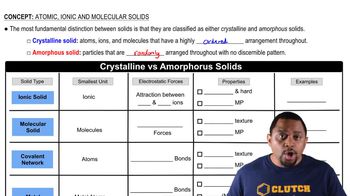
Covalent Network Solid

Covalent network solids are materials where atoms are bonded together by a continuous network of covalent bonds, resulting in a rigid structure. Examples include diamond and silicon carbide, which exhibit high melting points and hardness due to the strong bonding. These solids do not consist of discrete molecules but rather a vast array of atoms interconnected in a lattice.
추천 영상:
가이드 코스
04:13
Crystalline vs Amorphous Solids

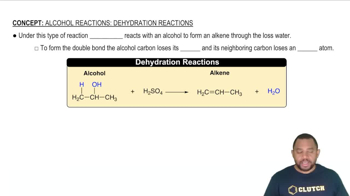
Disproportionation Reaction

A disproportionation reaction is a specific type of redox reaction in which a single substance is simultaneously oxidized and reduced, forming two different products. An example is the reaction of hydrogen peroxide (H2O2), which can decompose into water (H2O) and oxygen (O2). This reaction highlights the dual nature of certain compounds in chemical transformations.
추천 영상:
가이드 코스
01:30
Alcohol Reactions: Dehydration Reactions

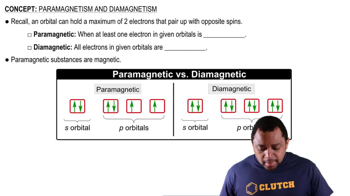
Paramagnetic Oxide

Paramagnetic oxides contain unpaired electrons in their electronic structure, which allows them to be attracted to magnetic fields. A common example is manganese(II) oxide (MnO), where the manganese ion has unpaired d-electrons. This property is significant in understanding the magnetic behavior of materials and their applications in various technologies.
추천 영상:
가이드 코스
01:33
Paramagnetism and Diamagnetism