Ch.7 - Covalent Bonding and Electron-Dot Structures
McMurry - Chemistry 8th Edition
McMurry8th EditionChemistryISBN: 9781292336145당신이 사용하는 게 아니라요?교과서 변경
7장, 문제 73

Identify the fourth-row elements, X, that form the following compounds.(a) Lewis dot structure showing bromine atoms and an unknown fourth-row element X.

검증된 단계별 안내
1
Identify the number of valence electrons for bromine (Br), which is 7.
Count the total number of bromine atoms bonded to the central atom X, which is 5.
Calculate the total number of valence electrons contributed by the bromine atoms: 5 bromine atoms * 7 valence electrons each = 35 valence electrons.
Determine the total number of valence electrons around the central atom X, including the lone pair electrons shown in the structure.
Identify the fourth-row element X that can accommodate 5 bonds and has the appropriate number of valence electrons to match the structure, which is iodine (I).

비슷한 문제에 대한 검증된 영상 답변:

이 영상 해법은 위 문제에 도움이 된다고 튜터들이 추천한 것입니다.
영상 길이:
2m
도움이 되었나요?

주요 개념

질문에 올바르게 답하기 위해 반드시 이해해야 하는 핵심 개념들은 다음과 같습니다.

Lewis Structures

Lewis structures are diagrams that represent the bonding between atoms and the lone pairs of electrons in a molecule. They use dots to show valence electrons and lines to indicate bonds. Understanding Lewis structures is essential for predicting molecular geometry and reactivity, as they provide insight into how atoms are connected and the distribution of electrons.
추천 영상:
가이드 코스
04:28
Lewis Dot Structures: Ions

Group Trends in the Periodic Table

Elements in the same group of the periodic table exhibit similar chemical properties due to having the same number of valence electrons. For fourth-row elements, this includes elements like gallium, germanium, and arsenic. Recognizing these trends helps in predicting how an unknown element, represented as X in the question, might behave in chemical reactions, especially when forming compounds with halogens like bromine.
추천 영상:
가이드 코스
05:33
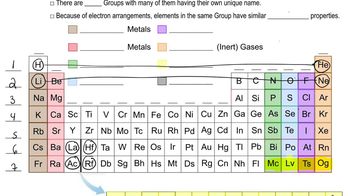
Periodic Table: Group Names

Covalent Bonding

Covalent bonding occurs when two atoms share one or more pairs of electrons, typically between nonmetals. In the context of the question, the unknown element X is likely forming covalent bonds with bromine atoms. Understanding covalent bonding is crucial for determining the molecular structure and properties of the resulting compounds, as it influences bond angles, lengths, and overall molecular geometry.
추천 영상: