Order the following elements according to decreasing electronegativity: C, Ca, Cs, Cl, Cu.
검증된 단계별 안내
1
Step 1: Understand the concept of electronegativity, which is the ability of an atom to attract electrons in a chemical bond. Electronegativity values are typically found on the Pauling scale.
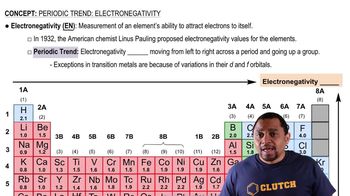
Step 2: Recall the general trend of electronegativity on the periodic table: it increases across a period (from left to right) and decreases down a group (from top to bottom).
Step 3: Identify the positions of the given elements on the periodic table: Carbon (C) is in group 14, period 2; Calcium (Ca) is in group 2, period 4; Cesium (Cs) is in group 1, period 6; Chlorine (Cl) is in group 17, period 3; Copper (Cu) is in group 11, period 4.
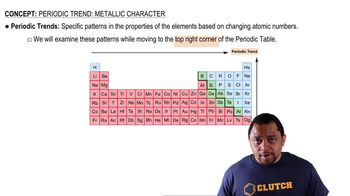
Step 4: Apply the periodic trend to estimate the electronegativity of each element. Chlorine, being in the top right (excluding noble gases), is expected to have the highest electronegativity. Cesium, being in the bottom left, is expected to have the lowest.
Step 5: Order the elements from highest to lowest electronegativity based on their positions and the periodic trend: Cl, C, Cu, Ca, Cs.
주요 개념
질문에 올바르게 답하기 위해 반드시 이해해야 하는 핵심 개념들은 다음과 같습니다.
Electronegativity
Electronegativity is a measure of an atom's ability to attract and hold onto electrons when it forms a chemical bond. It is a dimensionless quantity typically measured on the Pauling scale, where higher values indicate a stronger attraction for electrons. Understanding electronegativity is crucial for predicting how atoms will interact in compounds and the nature of the bonds they will form.
Periodic trends refer to the predictable patterns observed in the properties of elements across the periodic table. Electronegativity generally increases from left to right across a period and decreases from top to bottom within a group. Recognizing these trends helps in ordering elements based on their electronegativity and understanding their chemical behavior.
When comparing elements for electronegativity, it is essential to consider their positions in the periodic table. For instance, nonmetals like chlorine (Cl) typically have higher electronegativity than metals like calcium (Ca) and cesium (Cs). Additionally, transition metals like copper (Cu) can have variable electronegativity values, making it important to reference reliable data when ordering elements.