Ch.7 - Covalent Bonding and Electron-Dot Structures
McMurry - Chemistry 8th Edition
McMurry8th EditionChemistryISBN: 9781292336145당신이 사용하는 게 아니라요?교과서 변경
7장, 문제 5

Which compound is a solid at room temperature? (LO 7.8)(a) H2O(b) Na2S (c) SO3 (d) Cl2

검증된 단계별 안내
1
insert step 1> Identify the type of bonding and structure for each compound.
insert step 2> Consider the typical state of matter for each type of compound at room temperature.
insert step 3> Recognize that ionic compounds, like Na2S, are usually solids at room temperature due to strong ionic bonds.
insert step 4> Note that molecular compounds, like H2O, SO3, and Cl2, are often gases or liquids at room temperature, except for water which is a liquid.
insert step 5> Conclude that Na2S is the compound that is a solid at room temperature.

비슷한 문제에 대한 검증된 영상 답변:

이 영상 해법은 위 문제에 도움이 된다고 튜터들이 추천한 것입니다.
영상 길이:
4m
도움이 되었나요?

주요 개념

질문에 올바르게 답하기 위해 반드시 이해해야 하는 핵심 개념들은 다음과 같습니다.

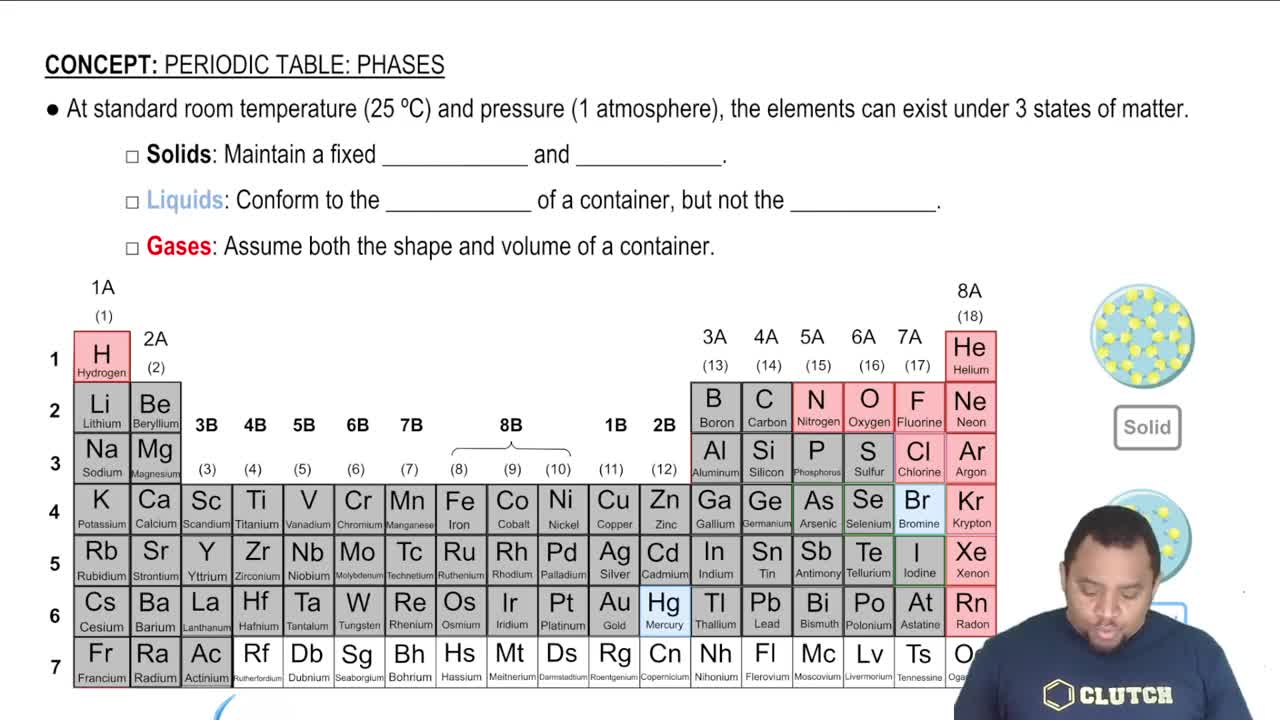
States of Matter

Matter exists in different states: solid, liquid, and gas, depending on temperature and pressure. At room temperature (approximately 20-25°C), substances can be classified based on their molecular structure and intermolecular forces. Solids have tightly packed particles that vibrate in place, while liquids have more space between particles, allowing them to flow.
추천 영상:
가이드 코스
03:25
Element States of Matter

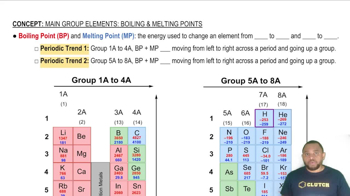
Melting Point

The melting point is the temperature at which a solid becomes a liquid. Compounds with high melting points tend to remain solid at room temperature. Understanding the melting points of various compounds helps in predicting their state at given temperatures, which is crucial for answering questions about their physical properties.
추천 영상:
가이드 코스
04:29
Boiling Point and Melting Point

Ionic vs. Molecular Compounds

Ionic compounds, such as Na2S, typically form solid structures at room temperature due to strong electrostatic forces between ions. In contrast, molecular compounds like H2O, SO3, and Cl2 may exist as liquids or gases at room temperature, depending on their molecular interactions. Recognizing the differences between these types of compounds aids in determining their physical states.
추천 영상:
가이드 코스
02:11
Ionic Compounds Naming