A virus has a diameter of 5.2 * 10-8 m. What is the most appropriate prefix for reporting the diameter of the virus?
검증된 단계별 안내
1
insert step 1> Identify the given diameter of the virus, which is \(5.2 \times 10^{-8}\) meters.
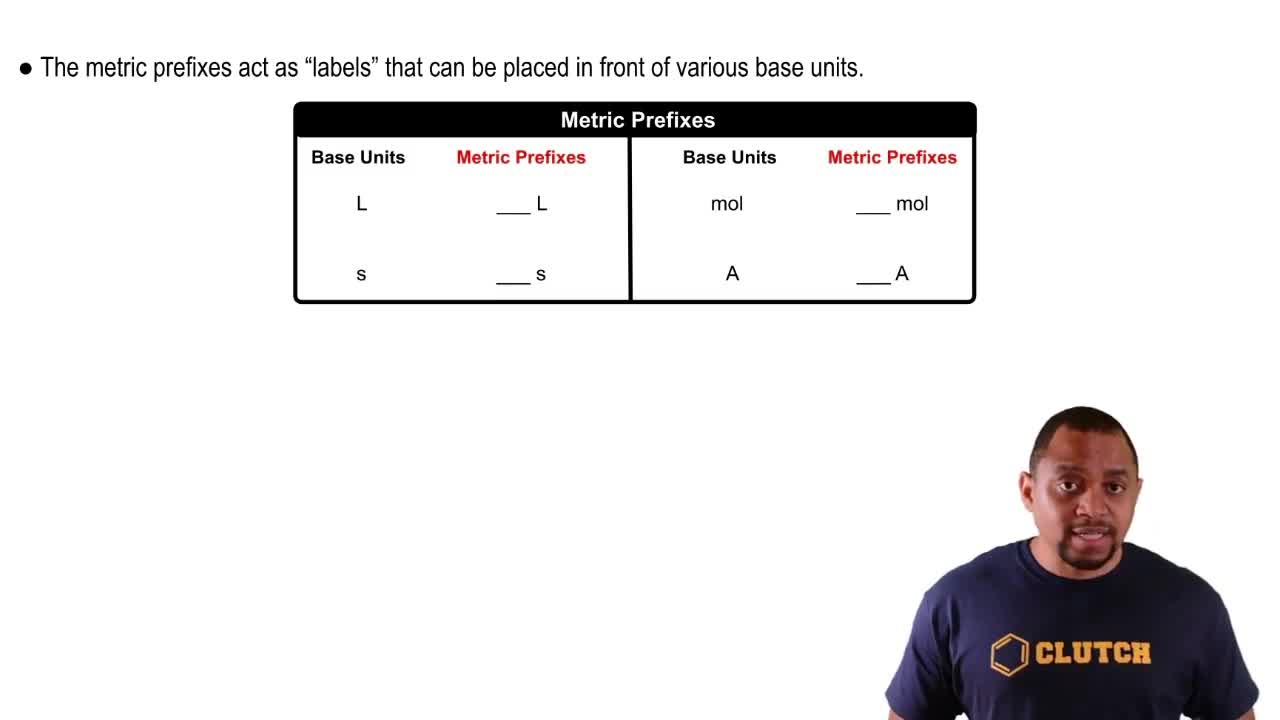
insert step 2> Recall the metric prefixes and their corresponding powers of ten: nano (n) is \(10^{-9}\), micro (\(\mu\)\) is \(10^{-6}\), milli (m) is \(10^{-3}\), etc.
insert step 3> Compare the given power of ten, \(10^{-8}\), with the standard metric prefixes to find the closest match.
insert step 4> Determine which prefix corresponds to a power of ten that is closest to \(10^{-8}\).
insert step 5> Conclude that the most appropriate prefix for the diameter of the virus is the one that matches or is closest to \(10^{-8}\).
비슷한 문제에 대한 검증된 영상 답변:
이 영상 해법은 위 문제에 도움이 된다고 튜터들이 추천한 것입니다.
영상 길이:
1m
영상 재생:
0 댓글
주요 개념
질문에 올바르게 답하기 위해 반드시 이해해야 하는 핵심 개념들은 다음과 같습니다.
Metric Prefixes
Metric prefixes are used to denote specific powers of ten, making it easier to express very large or very small numbers. Common prefixes include kilo- (10^3), centi- (10^-2), and nano- (10^-9). Understanding these prefixes helps in converting and comparing measurements in scientific contexts.
Scientific notation is a method of expressing numbers as a product of a coefficient and a power of ten. It simplifies the representation of very large or small values, such as 5.2 * 10^-8 m, which indicates that the number is 5.2 divided by 10 to the eighth power, or 0.000000052 m.
In biology, understanding the scale of microscopic entities like viruses is crucial. The diameter of a virus, typically in the nanometer range, can be compared to other biological structures, such as bacteria (1-10 micrometers) or cells (10-100 micrometers), to appreciate their relative sizes and implications for study.


 검증된 단계별 안내
 01:16
01:16