Ch.1 - Chemical Tools: Experimentation & Measurement
McMurry - Chemistry 8th Edition
McMurry8th EditionChemistryISBN: 9781292336145당신이 사용하는 게 아니라요?교과서 변경
1장, 문제 55

Of the 90 or so naturally occurring elements, only four are liquid near room temperature: mercury (melting point = -38.87 °C), bromine (melting point = -7.2 °C), cesium (melting point = 28.40 °C), and gallium (melting point = 29.78 °C). Convert these melting points to degrees Fahrenheit.

검증된 단계별 안내
1
Identify the formula for converting Celsius to Fahrenheit: \( F = \frac{9}{5}C + 32 \).
Substitute the melting point of mercury (-38.87 °C) into the formula: \( F = \frac{9}{5}(-38.87) + 32 \).
Substitute the melting point of bromine (-7.2 °C) into the formula: \( F = \frac{9}{5}(-7.2) + 32 \).
Substitute the melting point of cesium (28.40 °C) into the formula: \( F = \frac{9}{5}(28.40) + 32 \).
Substitute the melting point of gallium (29.78 °C) into the formula: \( F = \frac{9}{5}(29.78) + 32 \).

비슷한 문제에 대한 검증된 영상 답변:

이 영상 해법은 위 문제에 도움이 된다고 튜터들이 추천한 것입니다.
영상 길이:
1m

주요 개념

질문에 올바르게 답하기 위해 반드시 이해해야 하는 핵심 개념들은 다음과 같습니다.

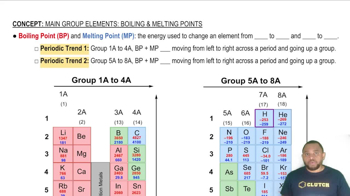
Melting Point

The melting point is the temperature at which a solid becomes a liquid at atmospheric pressure. It is a critical physical property that indicates the phase transition of a substance. For example, mercury melts at -38.87 °C, meaning it transitions from solid to liquid at this temperature.
추천 영상:
가이드 코스
04:29
Boiling Point and Melting Point

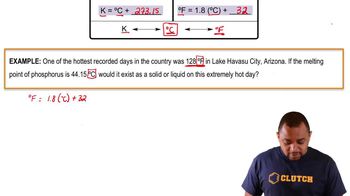
Temperature Conversion

Temperature conversion involves changing a temperature value from one scale to another, such as Celsius to Fahrenheit. The formula for converting Celsius to Fahrenheit is F = (C × 9/5) + 32. Understanding this conversion is essential for accurately interpreting temperature data across different measurement systems.
추천 영상:
가이드 코스
02:10
Temperature Conversion Example

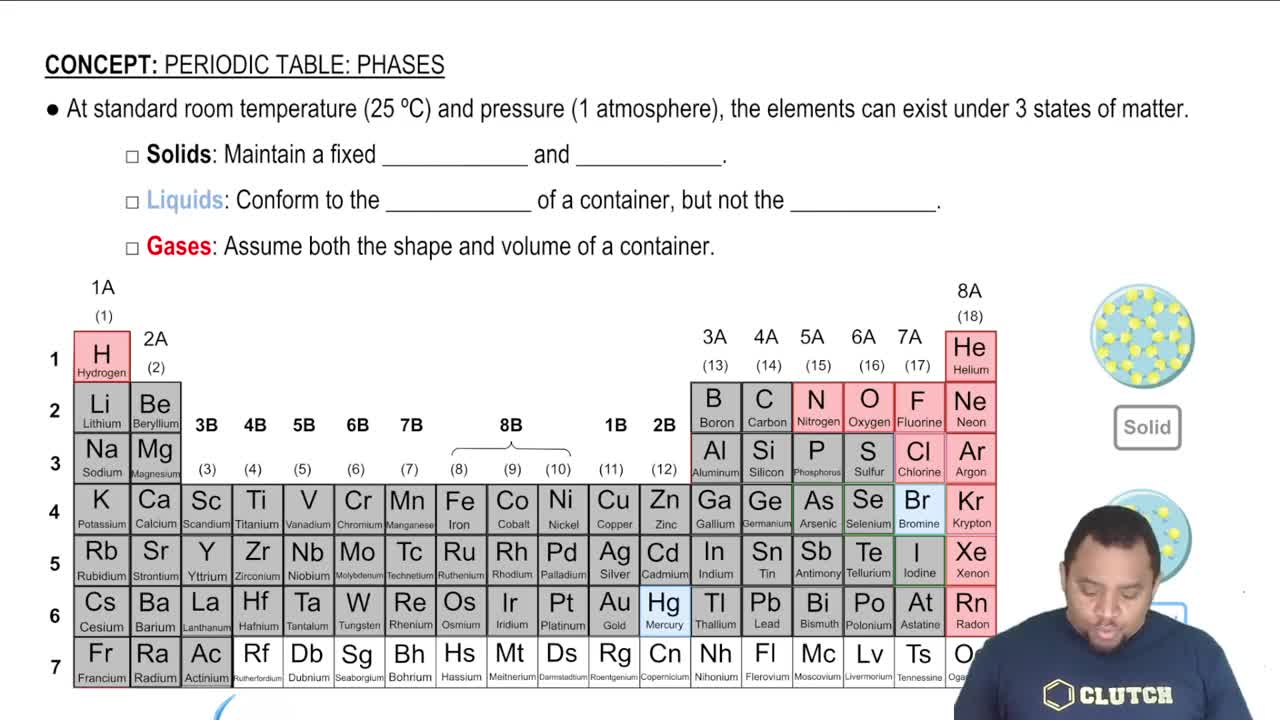
States of Matter

States of matter refer to the distinct forms that different phases of matter take on. The most common states are solid, liquid, and gas. The transition between these states, such as melting from solid to liquid, is influenced by temperature and pressure, which is crucial for understanding the behavior of elements like mercury and bromine near room temperature.
추천 영상:
가이드 코스
03:25
Element States of Matter